Context: the story behind the quote
Most quote apps show you a line and a name. In Luminora, Context shows who said a quote, when and why, and where it comes from, with a short note on the author or the work. In SEEK, flip any card for Context. In LEARN, tap Context on a literary quote. It is for readers who want to know what a famous line actually means, not only how it sounds.
What Context shows
- The quote and its source. Who said it, and the work it comes from.
- The background. A short note on when and why it was said, what the line refers to, and what was going on around it.
- The author. A brief biography: when they lived, what shaped them, why the work matters.
- In your language. The quote, the background and the biography can be read in English, Spanish, Japanese, Korean, Simplified Chinese, or Traditional Chinese.
Three real examples
Below are three quotes as they appeared in the app: a line from a novel and a Stoic line, both from LEARN, and a line from a poem that SEEK chose for a question. Each one shows the Context the app gave it, then a short summary of who, when, why and the source, then our own note on why the story changes the line.
From a novel: Nathaniel Hawthorne, The Scarlet Letter
This quote appeared in a LEARN collection on the day this page was written.
We dream in our waking moments, and walk in our sleep.
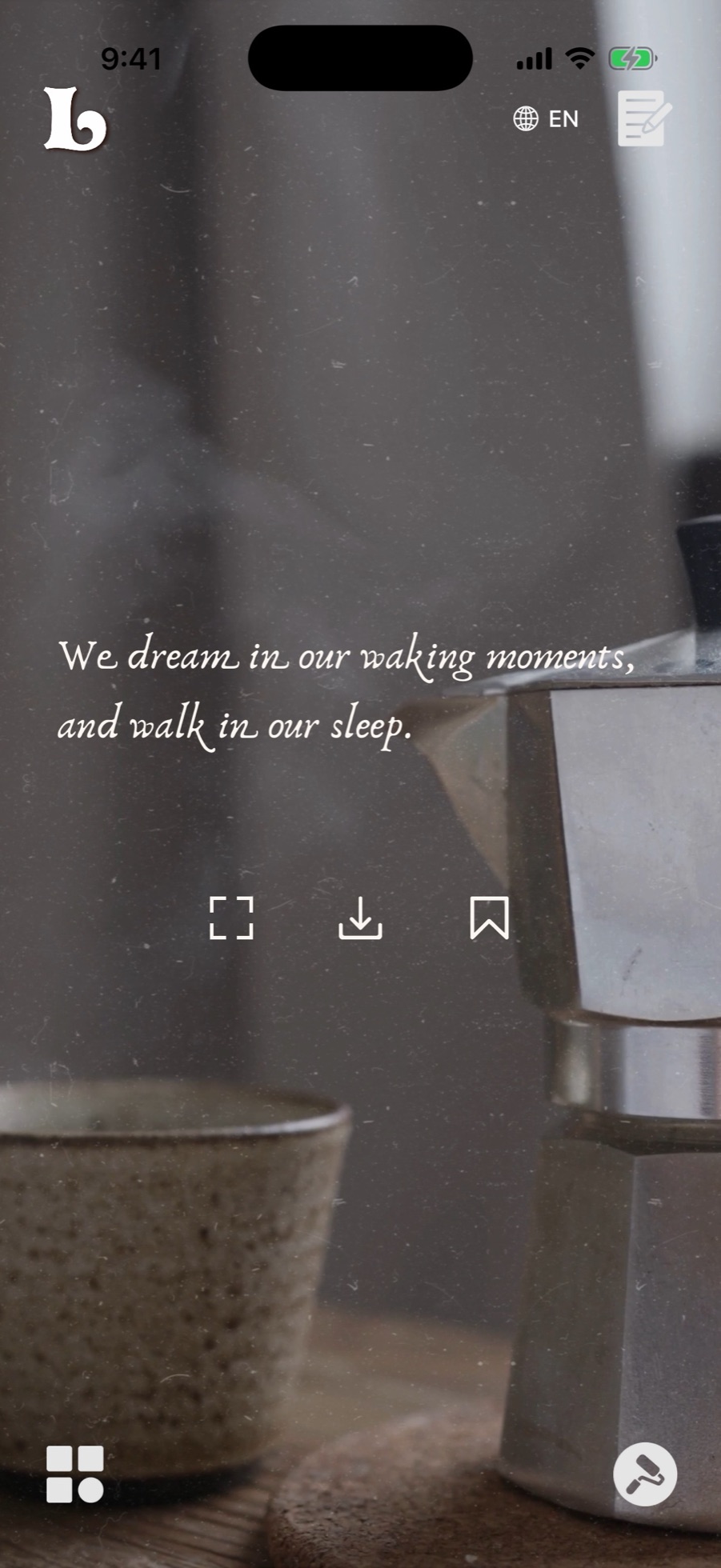
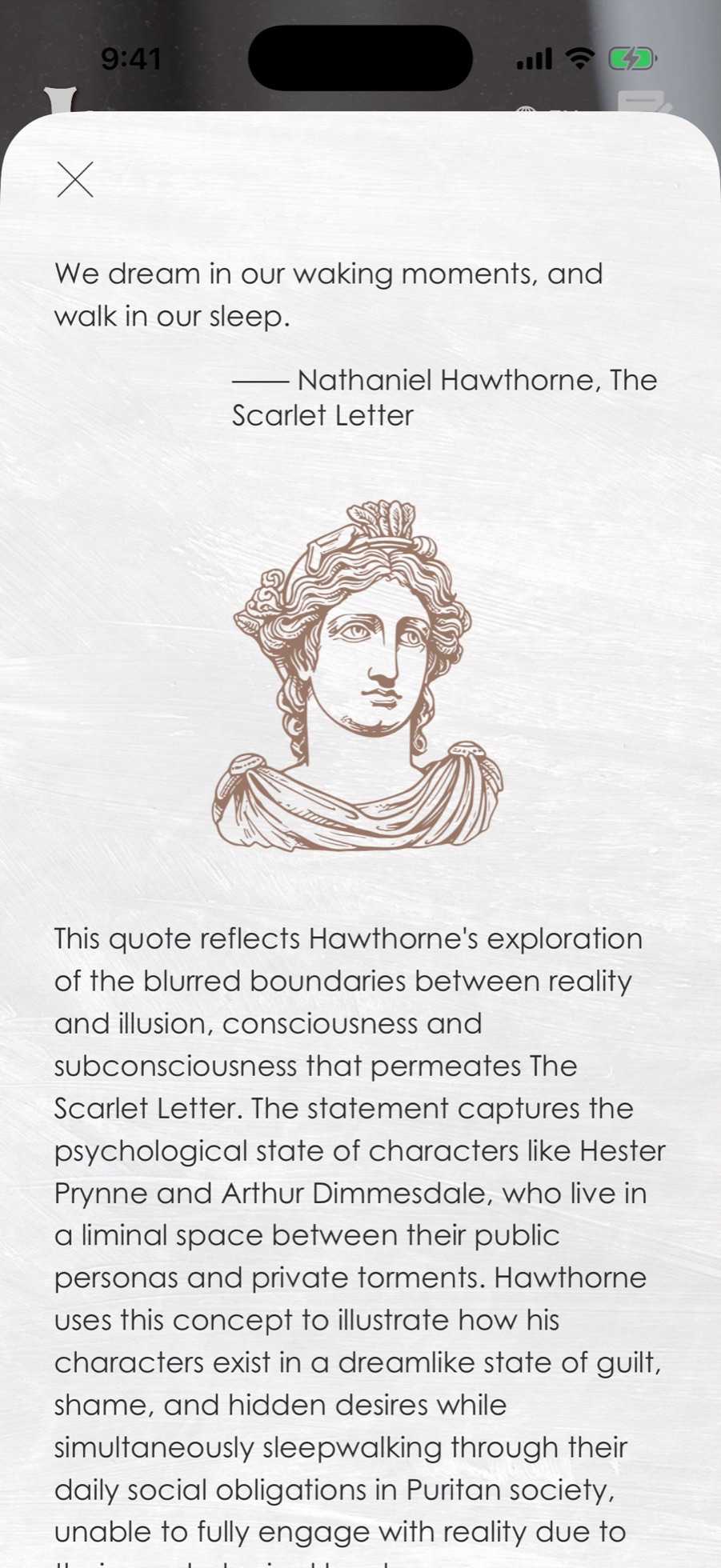
Tapping Context opens this note, quoted here as the app shows it:
This quote reflects Hawthorne’s exploration of the blurred boundaries between reality and illusion, consciousness and subconsciousness that permeates The Scarlet Letter. The statement captures the psychological state of characters like Hester Prynne and Arthur Dimmesdale, who live in a liminal space between their public personas and private torments. Hawthorne uses this concept to illustrate how his characters exist in a dreamlike state of guilt, shame, and hidden desires while simultaneously sleepwalking through their daily social obligations in Puritan society, unable to fully engage with reality due to their psychological burdens.
Below it, the biography begins:
Nathaniel Hawthorne (1804-1864) was an American novelist and short story writer, widely regarded as one of the most significant figures in American Romantic literature. Born in Salem, Massachusetts, into a family with deep Puritan roots, Hawthorne was profoundly influenced by his ancestral connection to the Salem witch trials, as his great-great-grandfather John Hathorne was a judge in the proceedings.
- Who
- Nathaniel Hawthorne (1804-1864) wrote it. In the novel, Roger Chillingworth says it to Arthur Dimmesdale.
- When
- Chapter 12, “The Minister’s Vigil”, at night, after Dimmesdale has climbed the town scaffold.
- Why
- Chillingworth offers sleepwalking as a polite explanation for what he has just seen.
- Source
- The Scarlet Letter, chapter 12, in the chapter text at Lit2Go.
Hawthorne’s dates are from the app’s biography. The rest is from our reading of the chapter.
Why the story changes the line
Read alone, the sentence sounds like a gentle thought about daydreaming. In the novel it is spoken in chapter 12, “The Minister’s Vigil”. Arthur Dimmesdale, driven by guilt he cannot confess, has climbed the town scaffold at night. Roger Chillingworth, the physician who has been quietly tormenting him, finds him there and says it as he leads the minister home, offering sleepwalking as a polite explanation for what he has just seen.
Knowing who says it, and to whom, turns a soft line into an unsettling one. That is what Context is for. You can read the scene in the chapter text at Lit2Go.
The summary and the two paragraphs above are our own editorial note, written for this page from the novel. The two quoted passages before them are from the app.
A Stoic line: Marcus Aurelius, Meditations
Stoic lines are usually shared as one-liners. This one was in LEARN when we captured it.
If it is not right, do not do it; if it is not true, do not say it.
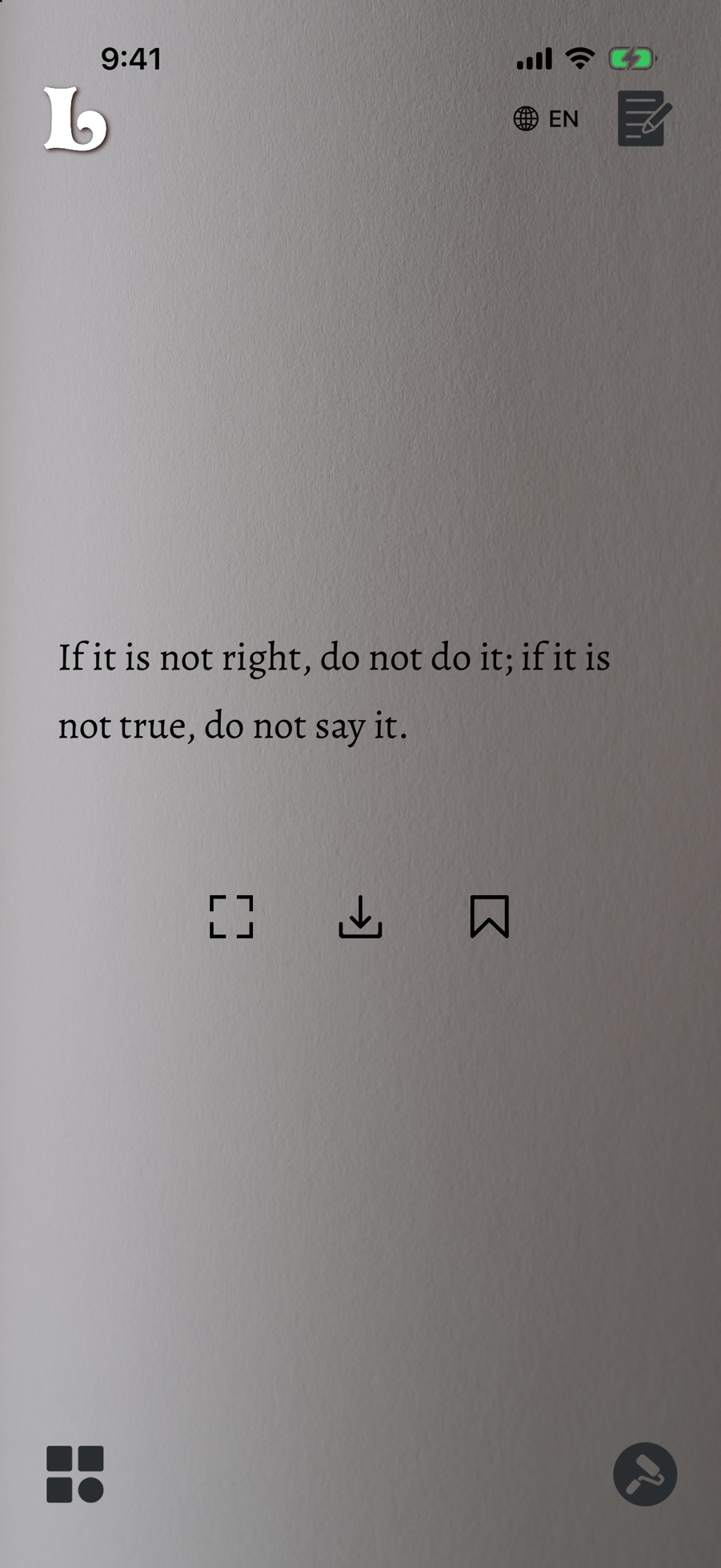
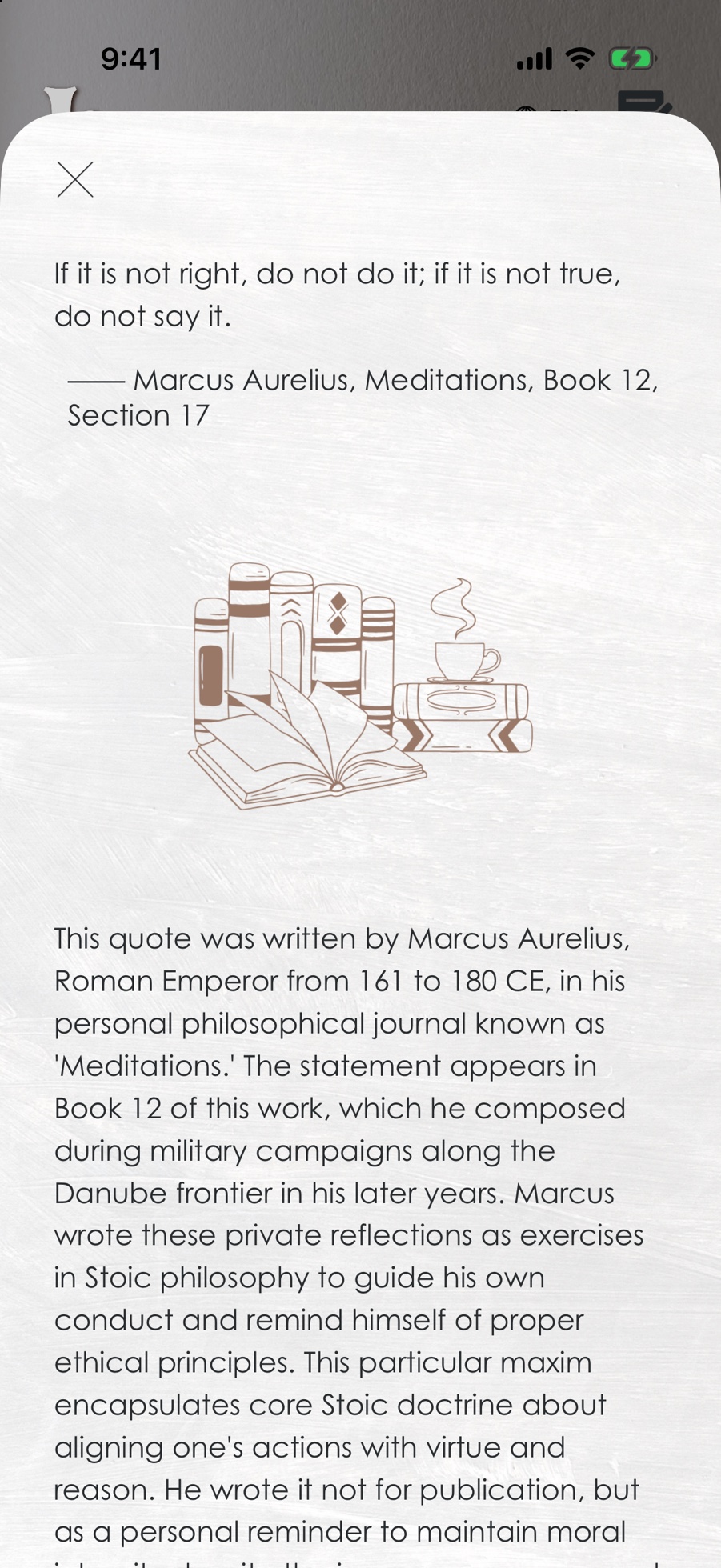
Its Context, quoted here as the app shows it:
This quote was written by Marcus Aurelius, Roman Emperor from 161 to 180 CE, in his personal philosophical journal known as ‘Meditations.’ The statement appears in Book 12 of this work, which he composed during military campaigns along the Danube frontier in his later years. Marcus wrote these private reflections as exercises in Stoic philosophy to guide his own conduct and remind himself of proper ethical principles. This particular maxim encapsulates core Stoic doctrine about aligning one’s actions with virtue and reason. He wrote it not for publication, but as a personal reminder to maintain moral integrity despite the immense pressures and temptations of imperial power.
- Who
- Marcus Aurelius, Roman emperor from 161 to 180 CE.
- When
- In Book 12 of the Meditations, written in his later years.
- Why
- As a private reminder to himself, not for publication.
- Source
- Meditations 12.17, in George Long’s translation at the Internet Classics Archive.
Who, when and why are as the app’s note gives them. The source is the one we checked.
Why the story changes the line
Read alone, the line sounds like a rule handed to other people. The note says who it was for: the emperor himself, in a notebook he never meant anyone to read. We checked the wording. George Long’s translation gives it as “If it is not right, do not do it: if it is not true, do not say it.”
The summary and the paragraph above are our own editorial note. The quoted passage before them is from the app.
A line from a poem, in SEEK: Robert Frost, The Road Not Taken
We asked SEEK, “I keep overthinking whether to leave a stable job to start something of my own.” On the other side of the Illumination card was this quote:
I took the one less traveled by, And that has made all the difference.
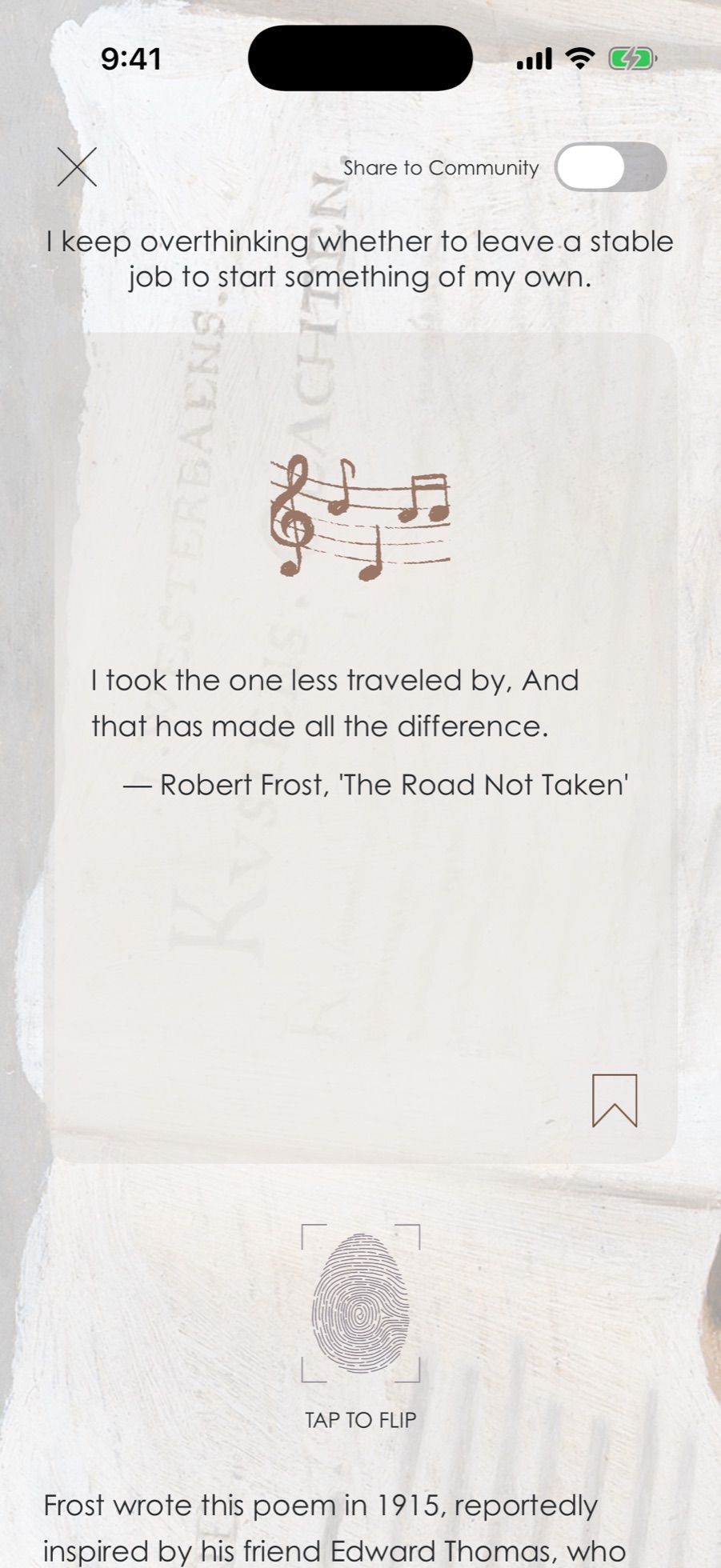
And beneath it, the background, quoted as the app shows it:
Frost wrote this poem in 1915, reportedly inspired by his friend Edward Thomas, who often agonized over which path to take on their walks together, only to regret whichever one he chose. The poem captures the universal anxiety of decision-making and the human tendency to mythologize our choices after the fact, even when the paths were nearly identical.
- Who
- Robert Frost.
- When
- In 1915.
- Why
- Reportedly prompted by his friend Edward Thomas, who agonized over which path to take on their walks.
- Source
- The last stanza of “The Road Not Taken”, as published at the Poetry Foundation.
Who, when and why are as the app’s note gives them. We independently checked only the wording of the quoted lines against the published poem.
Why the story changes the line
The line is usually quoted as a cheer for bold choices. The note says the poem is about how we agonize and then tell ourselves a story afterwards, which is a more useful thing to read when you are overthinking a decision. The full example, with the question and both sides of the card, is on the SEEK page.
The summary and the paragraph above are our own editorial note. The quoted passage before them is from the app. SEEK’s quote and note are produced when you ask, so a different question brings a different line.
Book quotes, with the author’s story
The Hawthorne example is a book quote: a line from a novel, shown with the scene it belongs to and a biography of the author who wrote it. Context works the same way for lines from poems, essays and philosophy.
For another line from a philosopher, Heraclitus on time, see philosophy quotes, with the idea behind each line.
The same idea, in the Journal
We also write out the story behind famous lines that are often misread or misquoted. Each article gives the exact wording, who says it, and what it means in its place.
- “People Will Forget What You Said”: The Line Credited to Maya Angelou Is Older
- “We Are What We Repeatedly Do”: Will Durant’s Line, Not Aristotle’s
- “Be Yourself; Everyone Else Is Already Taken”: Oscar Wilde Did Not Write It
- “You Miss 100% of the Shots You Don’t Take”: What Wayne Gretzky Actually Said
- “Give Me Liberty, or Give Me Death”: The Speech Was Printed 41 Years Later
- “Et Tu, Brute?”: Caesar’s Famous Last Words Are Shakespeare’s
- Affirmation Quotes From Real People: “I Am” Lines and the Stories Behind Them
- “Well-Behaved Women Seldom Make History”: The Author Meant It as a Complaint
- “Insanity Is Doing the Same Thing Over and Over”: Einstein Did Not Say It
- “The Ends Justify the Means”: The Sentence Is Not in The Prince
- “Be the Change You Wish to See in the World”: What Gandhi Actually Wrote
- “Elementary, My Dear Watson”: Holmes Never Says It in the Stories
- “Let Them Eat Cake”: The Story Is Older Than Marie Antoinette
- “Now Is the Winter of Our Discontent”: The Sentence Does Not Stop There
- “Wherefore Art Thou Romeo?”: Juliet Is Not Asking Where He Is
- “Good Fences Make Good Neighbors”: Who Says It in Frost’s Poem
- “Carpe Diem”: What Horace Actually Meant by “Seize the Day”
- “The Road Not Taken” Meaning: What Frost’s Poem Actually Says
- “To Thine Own Self Be True”: What Polonius Actually Meant
- “Power Corrupts”: Acton Wrote “Tends to,” and He Was Talking About Historians
- “’Tis Better to Have Loved and Lost”: Tennyson Wrote It for a Friend
- “Hell Is Other People”: What Sartre Said He Meant
- “The Unexamined Life Is Not Worth Living”: What Socrates Was Refusing
- “God Is Dead”: Who Says It in Nietzsche, and to Whom
- “I Think, Therefore I Am”: What Descartes Was Trying to Prove
- “Ignorance Is Bliss”: The Line Begins With “Where”
- “Money Is the Root of All Evil”: The Verse Says “the Love of Money”
- Read English and Spanish Quotes on iPhone with Luminora
- Affirmations vs. Quotes: Choosing Words That Feel Right
Where to find it
In SEEK, on every card. Ask a question and flip the Illumination card. The other side holds the quote and its Context, including the source, the story behind the line, and a short biography of the author.
In LEARN, on literary quotes. Lines from novels, poems, essays and philosophy have Context. LEARN also includes short reflections that have no author, and those have no Context.
- Open LEARN and choose a collection.
- On a literary quote, tap the note icon in the top right corner.
- Scroll to read the background and the biography. Use the language button to read them in another language.
What is checked
Every quote in LEARN is checked by a person before it is published: the wording and who said it. The background notes, biographies and translations are prepared with AI assistance to accompany the quote. If you find an error in any of them, write to hi@luminoradaily.com with the quote and a source, and we will correct it.
In SEEK, where you ask a question and receive a quote, the quote and its Context are produced at the moment you ask and are not individually reviewed.
Is it free?
Luminora is free to download. Four LEARN collections are open to everyone each day, chosen at random, and Context is available on their literary quotes. You can also ask a limited number of questions in SEEK without paying. Luminora Premium unlocks every collection and unlimited questions in SEEK.
View Luminora on the App Store