“’Tis better to have loved and lost / Than never to have loved at all” is usually said to someone whose romance has ended. Tennyson wrote it about a death. The lines come from In Memoriam, his elegy for Arthur Henry Hallam, the friend whose sudden death in 1833 shaped much of his writing. [1] [2]
The line, exactly
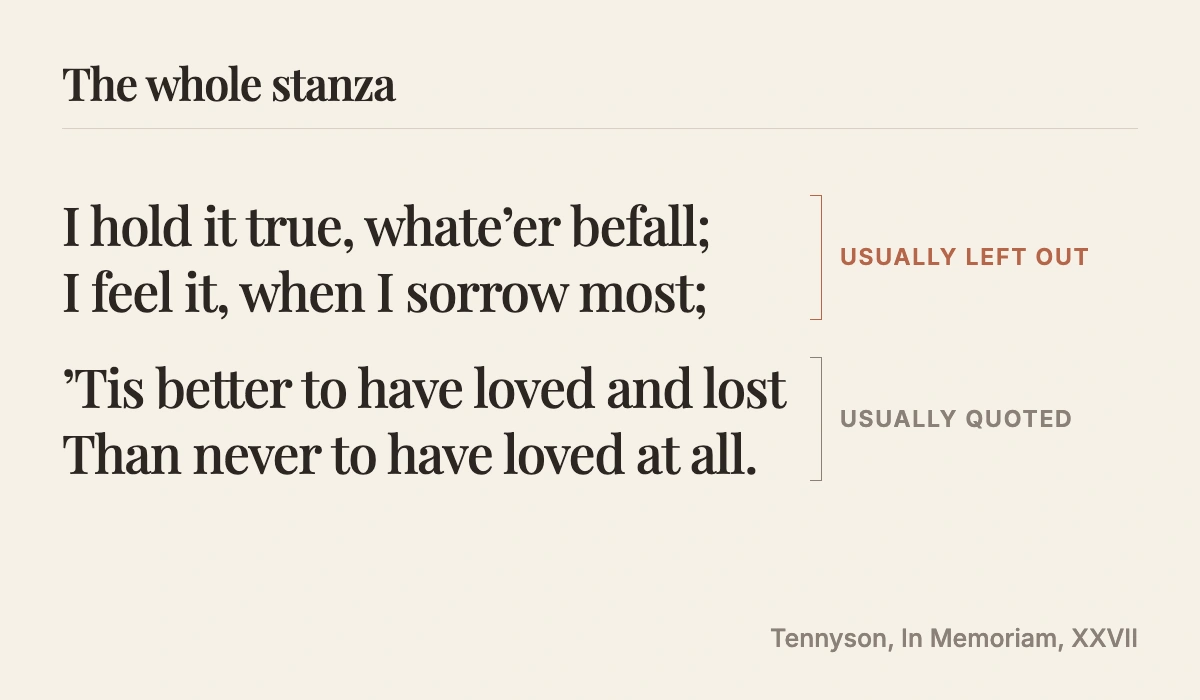
I hold it true, whate’er befall;
I feel it, when I sorrow most;
’Tis better to have loved and lost
Than never to have loved at all.
Alfred Tennyson, In Memoriam, section XXVII, the last stanza. The poem was published in 1850. [1]
Who it was written for
Tennyson met Arthur Henry Hallam at Cambridge, where Hallam led the undergraduate literary club that first took the shy young poet seriously. They “became the best of friends” and travelled in Europe together in 1830 and 1832. Hallam died suddenly in 1833. The Academy of American Poets describes In Memoriam and many of Tennyson’s other poems as tributes to him. [2]
Where it sits in the poem
In Memoriam is a long sequence of short sections written over many years of grief. Section XXVII is a list of people the poet does not envy: “the captive void of noble rage,” the caged linnet “that never knew the summer woods,” the heart “that never plighted troth.” Each has been spared pain by never having had the thing that could be lost. The famous stanza is his conclusion: he would not trade places with any of them. [1]
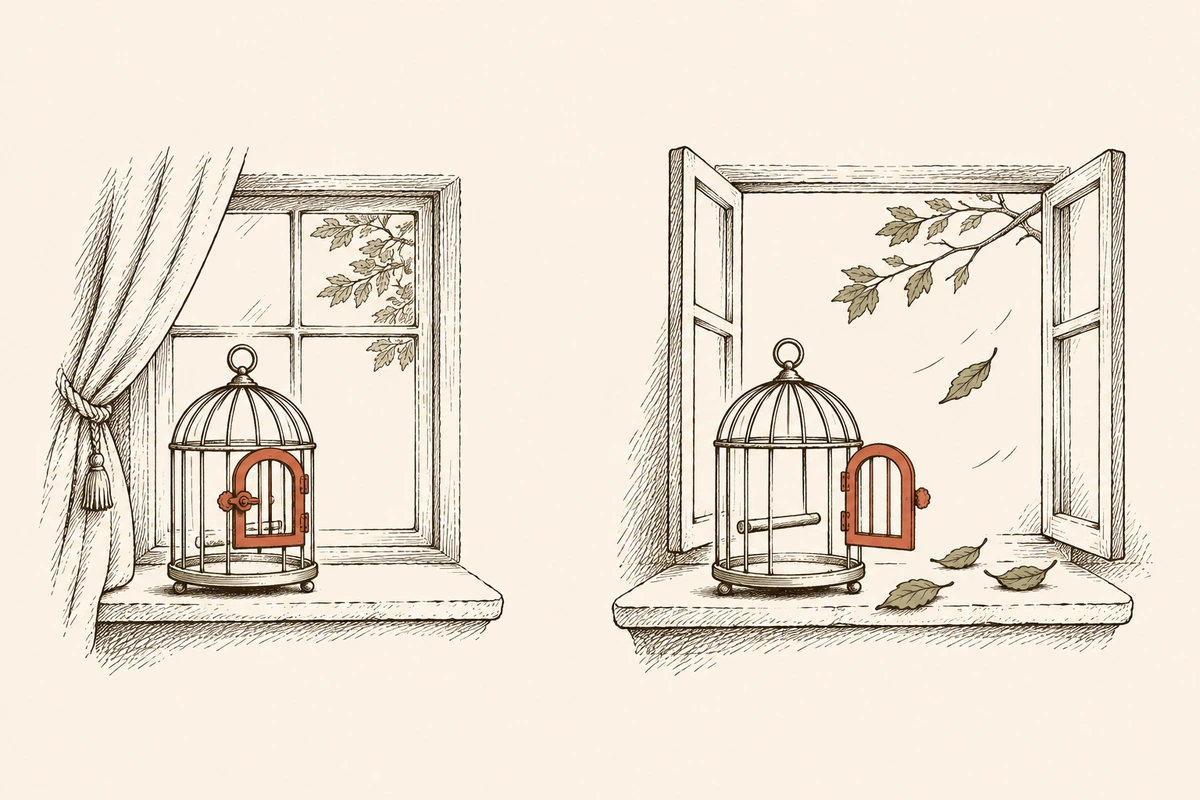
He says it twice. Much later in the poem the couplet returns, with the tense changed to show time has passed: “This truth came borne with bier and pall, / I felt it, when I sorrow’d most.” The first time it is a belief he is holding on to. The second time he has lived with it. [1]
What it means there
“Loved and lost” means loved someone who died. The claim is strong: even at the worst of mourning, he would choose the friendship and the grief over a life without either. Notice “when I sorrow most.” He does not say the pain is small. He says the love was worth it at the moment the pain is greatest.
How it is usually used
The couplet is now standard comfort after a breakup, and often a slightly brisk one: you had a good run. It works there, because the thought is general enough to travel. But it was earned in a harder place, and it is about a friend. In the poem, “love” covers friendship as fully as romance.
Should you still quote it?
Our view: yes, and say all four lines when you can. The first two carry the weight: this is something he feels at his lowest. And it is worth remembering the next time a friendship ends or a friend dies that the most quoted lines in English about lost love were written for exactly that.