
“The unexamined life is not worth living” is usually taken as gentle advice to reflect on yourself. In Plato’s Apology, Socrates says it in court, just after being found guilty, as his reason for refusing the one deal that might have saved him: go away and stop talking. [1]
The line, exactly
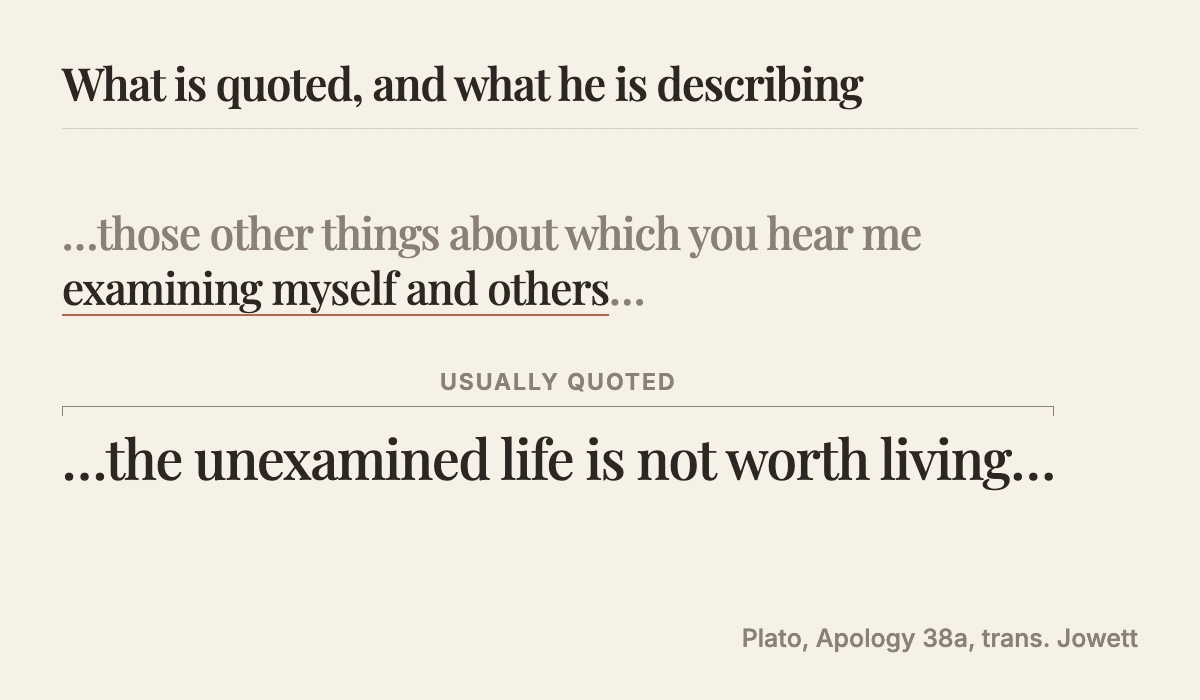
…and if I say again that daily to discourse about virtue, and of those other things about which you hear me examining myself and others, is the greatest good of man, and that the unexamined life is not worth living, you are still less likely to believe me.
Plato, Apology, section 38a, in Benjamin Jowett’s translation. Harold North Fowler’s translation gives the key words the same way: “the unexamined life is not worth living.” [1] [2]
Where it sits
The Apology is Plato’s account of the speech Socrates gave at his trial in Athens. By this point the jury has convicted him. Athenian procedure now lets him propose his own penalty, and he goes through the options aloud. Prison? A fine he cannot pay? Exile? [1]
He imagines someone offering the obvious way out: “Yes, Socrates, but cannot you hold your tongue, and then you may go into a foreign city, and no one will interfere with you?” His answer is the famous sentence. To be silent would be to disobey the god, he says, and you will not believe that. And if I tell you that talking every day about virtue is the greatest good there is, you will believe me even less. [1]

What it means there
Two things in the sentence are easy to miss. First, the examining is done out loud, with other people: “examining myself and others.” Socrates is describing his habit of questioning fellow citizens in public, the same habit that put him on trial. He does not mean a private journal. [1]
Second, the line is a refusal with a price. He is telling the people who will sentence him that a quiet life somewhere else is not a life he wants. The jury then votes for death.
How it is usually used
Today the sentence appears in books on self-knowledge, on therapy office walls and in graduation speeches, meaning: take time to think about who you are. That is a reasonable thing to want. It is a milder idea than the one in the speech, where examination is shared, argumentative and dangerous.
Should you still quote it?
Our view: yes, and keep “and others” in mind. The examined life in Plato is one where you let people question you and you question them back. It is harder than reflection alone, and it asks more courage.