“Be yourself; everyone else is already taken” is often credited to Oscar Wilde, and there is no substantive evidence that he said it. The earliest strong match Quote Investigator has found is an anonymous line at the end of an online post from December 1999, nearly a century after Wilde died. [1]
The line, exactly
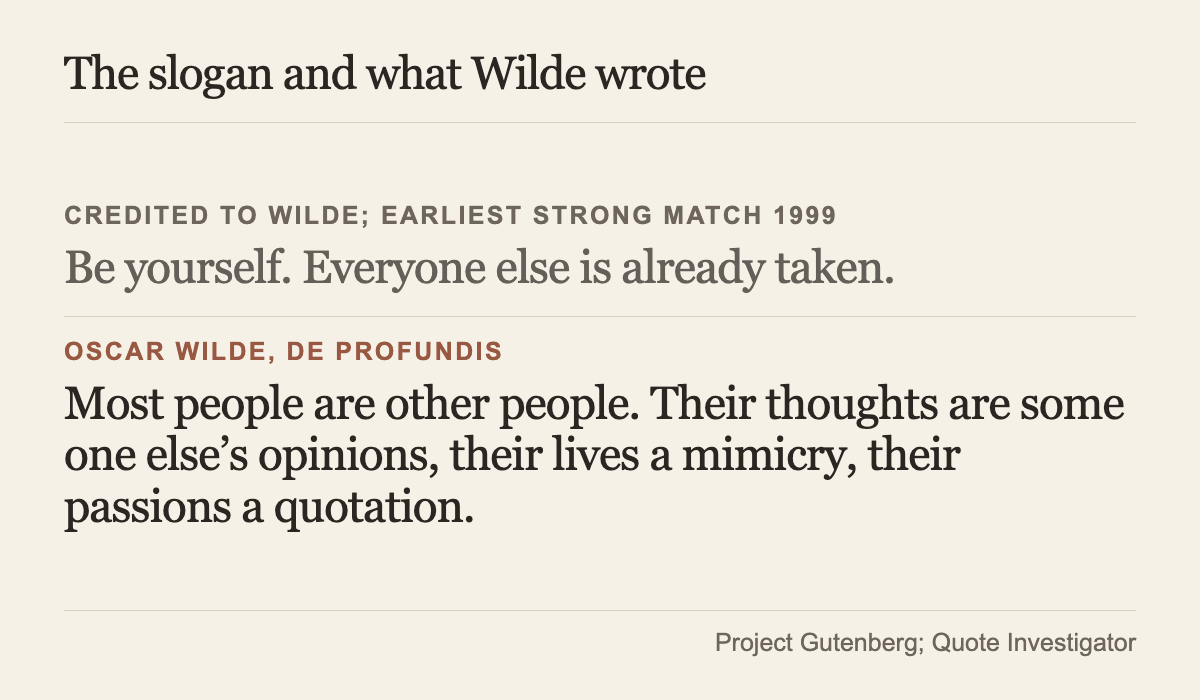
Be yourself. Everyone else is already taken.
As posted on the Usenet discussion system in December 1999, at the end of a message in a newsgroup used mainly by people in the Netherlands. It was in quotation marks with no name attached, which suggests it was already going around. [1]
Where it turns up
The nearest earlier thought comes from the spiritual writer Thomas Merton. In a 1967 essay he said he reserved the right to forget about being himself, since there was “very little chance of my being anybody else.” The joke is related, but the sentence is different. [1]
After the 1999 post the line moved quickly. In September 2000 a newspaper advertising supplement for Menards, a chain of Midwestern stores, printed “Be yourself. Everyone else is taken” at the foot of a page, with no credit. Shortly afterward it was being attributed to someone named Gilbert Perreira. [1]
What Wilde wrote about being yourself
Wilde returned to the subject often, and his lines point somewhere else. In De Profundis, written in prison and published in 1905, after his death in 1900, he says: “Most people are other people. Their thoughts are some one else’s opinions, their lives a mimicry, their passions a quotation.” [2] [1]
Elsewhere he doubts that a natural self is so easy to find. In The Picture of Dorian Gray, Lord Henry says, “Being natural is simply a pose, and the most irritating pose I know.” In an 1890 essay Wilde wrote, “Man is least himself when he talks in his own person. Give him a mask, and he will tell you the truth.” [1]
Quote Investigator’s summary is that Wilde composed several witticisms about identity and disguise, “but none was a strong match to the quotation.” [1]
How it is usually used
The line is used as friendly encouragement, on social profiles and in talks about confidence and personal branding. It works because it is quick and kind. Wilde’s name adds a flash of wit and a sense of permission from someone who paid a high price for being who he was. That borrowed authority is the part that does not hold up.
Should you still quote it?
Our view: use it if you like it, without his name. If you want Wilde himself, “Most people are other people” is shorter and much sharper. It also has an irony that suits this story: a man complaining that people’s passions are “a quotation” now has a quotation he never wrote.