
Philosophy quotes, with the idea behind each line
A line from a philosopher is usually the end of an argument, and a quote card shows only the end. In Luminora, a philosophy quote comes with its Context: where the line comes from, what the philosopher was arguing, and who they were.
What you get with a philosophy quote
- The line and who said it. The philosopher, and the work when the line comes from one.
- The idea behind it. A short note on what the line refers to and the view it belongs to.
- The philosopher. A brief biography: when they lived and what shaped their thinking.
- In your language. The quote and its note can be read in English, Spanish, Japanese, Korean, Simplified Chinese, or Traditional Chinese.
A real example
This quote was in the Philosophy & Insight collection in LEARN on the day this page was written.
Time is a game played beautifully by children.
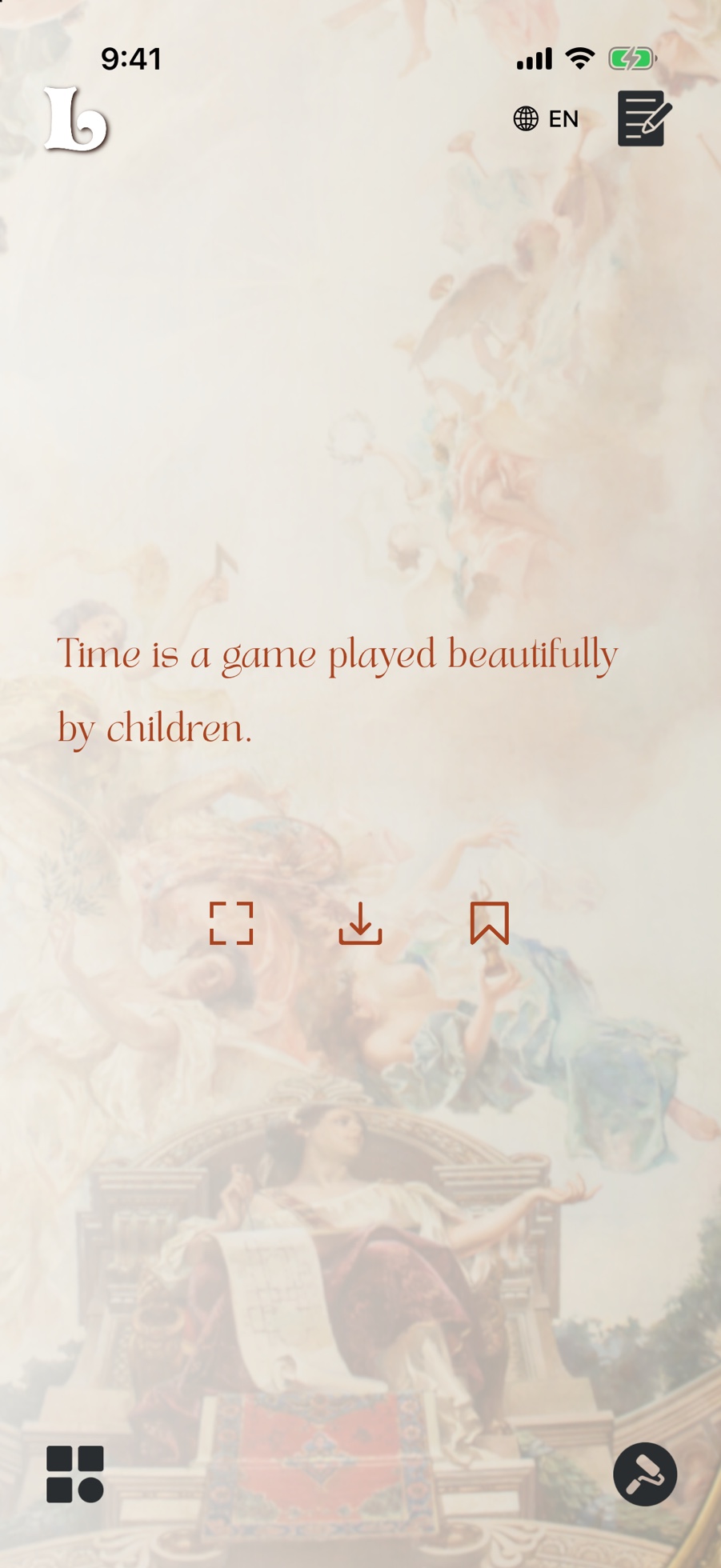
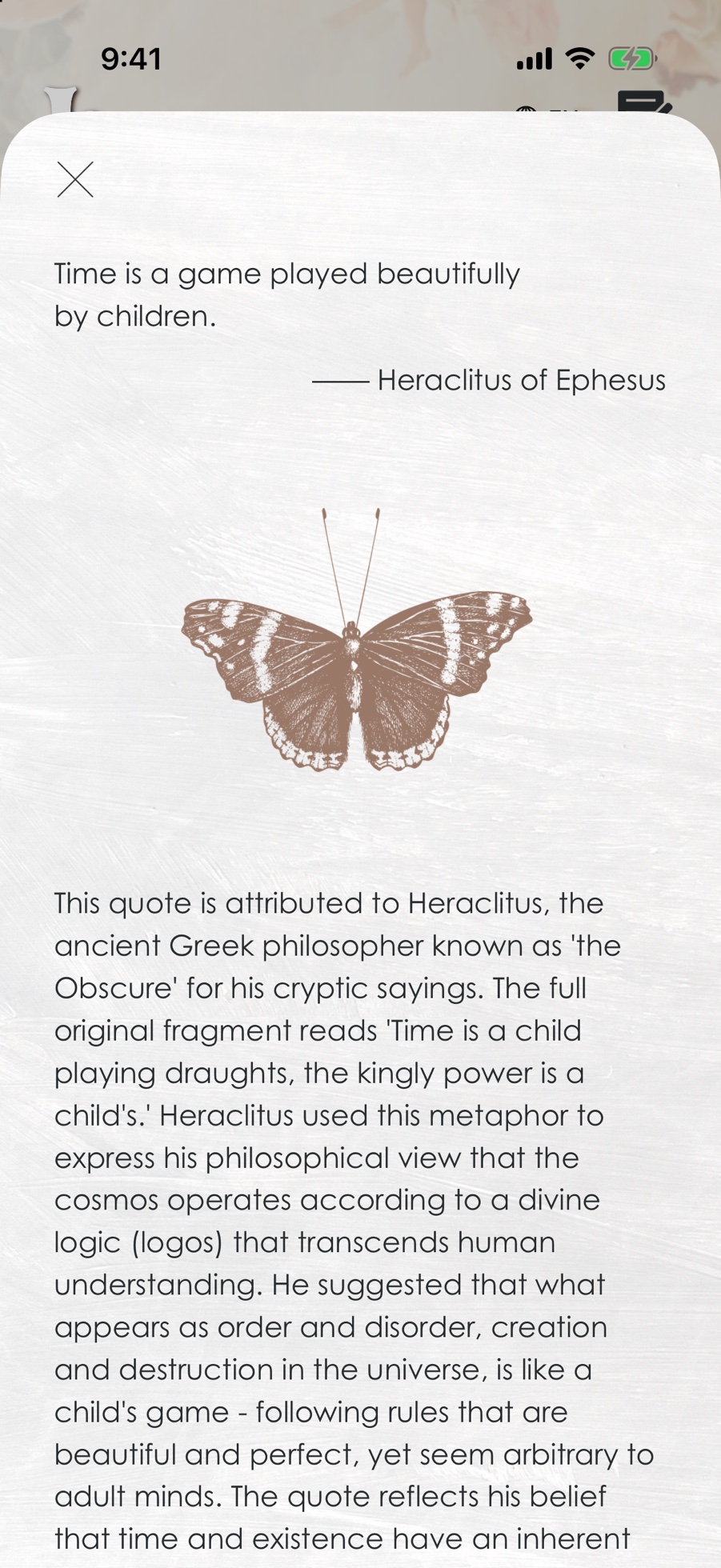
Tapping Context opens this note, quoted here as the app shows it:
This quote is attributed to Heraclitus, the ancient Greek philosopher known as ‘the Obscure’ for his cryptic sayings. The full original fragment reads ‘Time is a child playing draughts, the kingly power is a child’s.’ Heraclitus used this metaphor to express his philosophical view that the cosmos operates according to a divine logic (logos) that transcends human understanding. He suggested that what appears as order and disorder, creation and destruction in the universe, is like a child’s game - following rules that are beautiful and perfect, yet seem arbitrary to adult minds.
Why the note changes the line
On the card, the sentence reads like a kind thought about childhood. The note shows that the card carries a modern rewording, and gives the older translation next to it: a child playing a board game, and holding a king’s power. That is a stranger and harder idea than the card suggests, and it is closer to what Heraclitus left.
We checked the fragment. It is number 52 in the standard numbering, and John Burnet’s translation gives it in the same words as the note. You can read it in the Fragments of Heraclitus at Wikisource.
The two paragraphs above are our own editorial note, written for this page. The quoted passage before them is from the app.
Stoic quotes, with their context
Stoic lines are among the most shared quotes there are, and they are usually shared as one-liners. LEARN has lines from Marcus Aurelius, Seneca, Epictetus and Zeno, each with a note on where it comes from. This one is from Marcus Aurelius.
If it is not right, do not do it; if it is not true, do not say it.
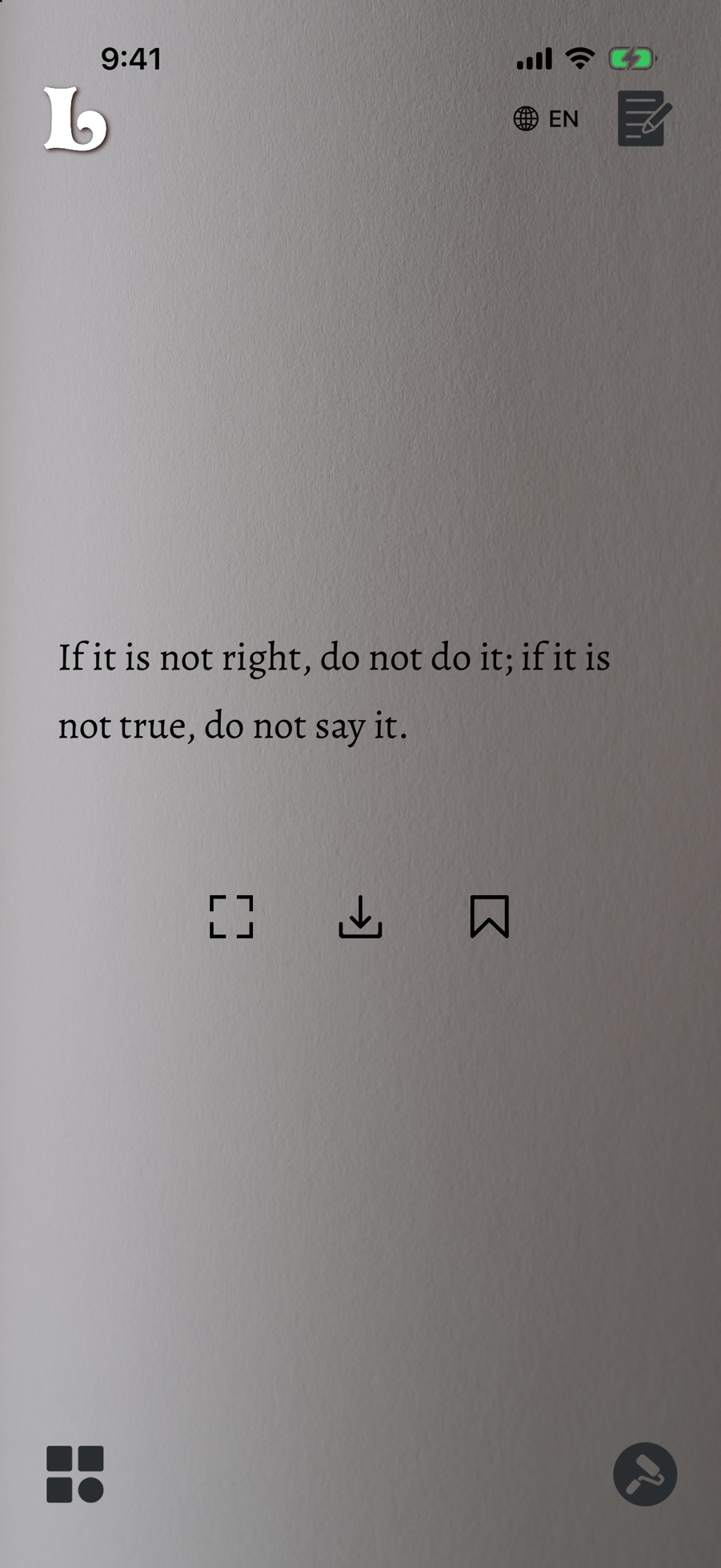
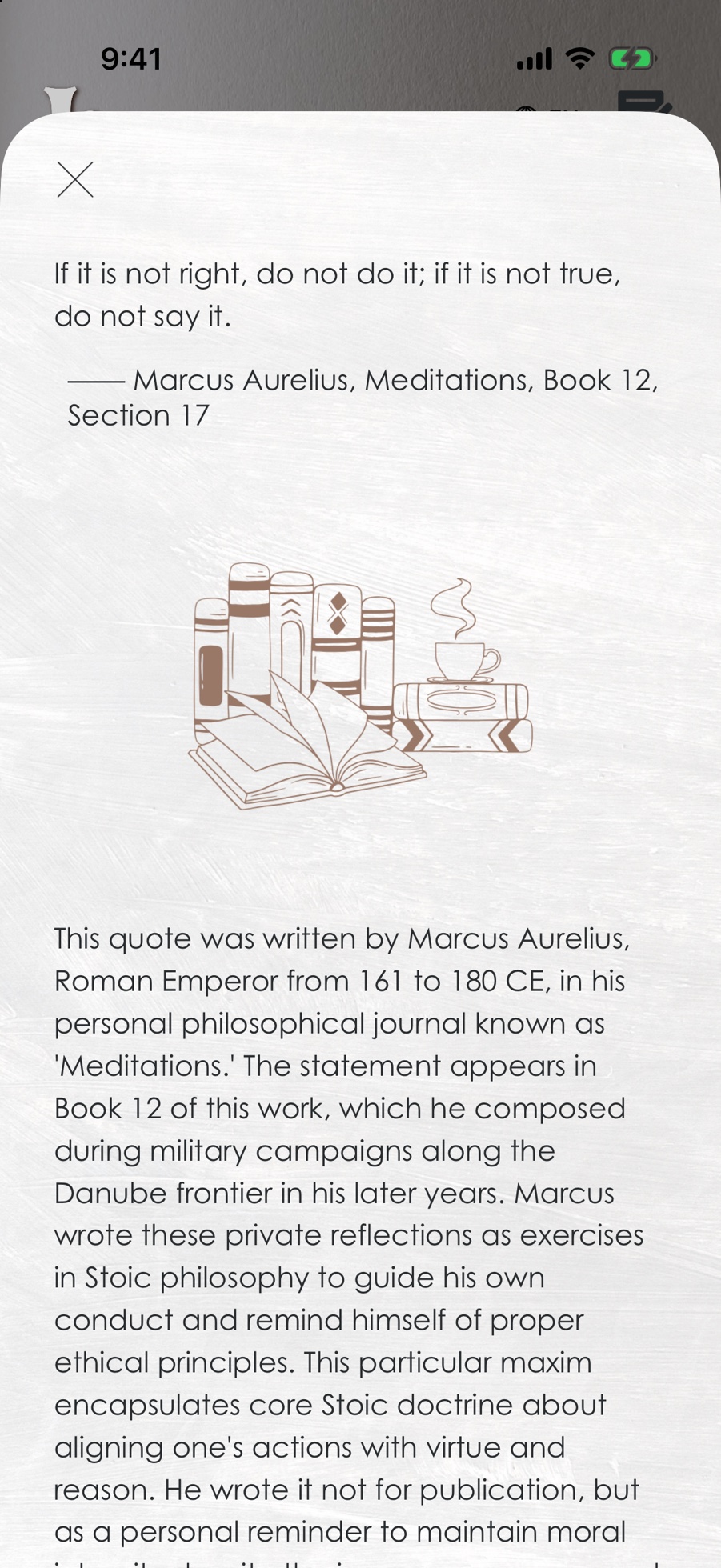
Its Context, quoted here as the app shows it:
This quote was written by Marcus Aurelius, Roman Emperor from 161 to 180 CE, in his personal philosophical journal known as ‘Meditations.’ The statement appears in Book 12 of this work, which he composed during military campaigns along the Danube frontier in his later years. Marcus wrote these private reflections as exercises in Stoic philosophy to guide his own conduct and remind himself of proper ethical principles. This particular maxim encapsulates core Stoic doctrine about aligning one’s actions with virtue and reason. He wrote it not for publication, but as a personal reminder to maintain moral integrity despite the immense pressures and temptations of imperial power.
Read alone, the line sounds like a rule handed to other people. The note says who it was for: the emperor himself, in a notebook he never meant anyone to read. We checked the wording. George Long’s translation gives Book 12, section 17 as “If it is not right, do not do it: if it is not true, do not say it.” You can read it in the Meditations at the Internet Classics Archive.
The Stoic lines are not gathered in one collection. They appear across LEARN, in collections such as Everyday Tasks, Spiritual Reflections and Philosophy & Insight.
The two paragraphs above are our own editorial note. The quoted passage before them is from the app.
Famous philosophy lines, written out in the Journal
For some of the most quoted lines in philosophy we have written the story out in full: the exact wording, who says it, and what it means in its place.
- “The Unexamined Life Is Not Worth Living”: What Socrates Was Refusing
- “I Think, Therefore I Am”: What Descartes Was Trying to Prove
- “God Is Dead”: Who Says It in Nietzsche, and to Whom
- “Hell Is Other People”: What Sartre Said He Meant
- “We Are What We Repeatedly Do”: Will Durant’s Line, Not Aristotle’s
- “The Ends Justify the Means”: The Sentence Is Not in The Prince
Where to find it
- Open LEARN and tap the collections button in the bottom left corner.
- Choose a collection. Philosophy & Insight and Taoist Wisdom were both there when this page was written; the search field finds a collection by name.
- On a quote, tap the note icon in the top right corner to open its Context.
Philosophy also turns up in other collections, next to lines from novels and poems. Not every quote has Context: short reflections with no author do not.
What is checked
Every quote in LEARN is checked by a person before it is published: the wording and who said it. The background notes, biographies and translations are prepared with AI assistance to accompany the quote. If you find an error in any of them, write to hi@luminoradaily.com with the quote and a source, and we will correct it.
Is it free?
Luminora is free to download. Four LEARN collections are open to everyone each day, chosen at random, so a given collection may not be open on a given day. Luminora Premium unlocks every collection.
View Luminora on the App Store