“Et tu, Brute?” means “And you, Brutus?” or “You too, Brutus?” It is what Shakespeare’s Caesar says as his friend stabs him, and there is no evidence the real Caesar said it. Suetonius writes that he died “uttering not a word,” and both he and Cassius Dio mention a short remark in Greek only as something others claimed. [1] [2] [3] [8]
The line, exactly
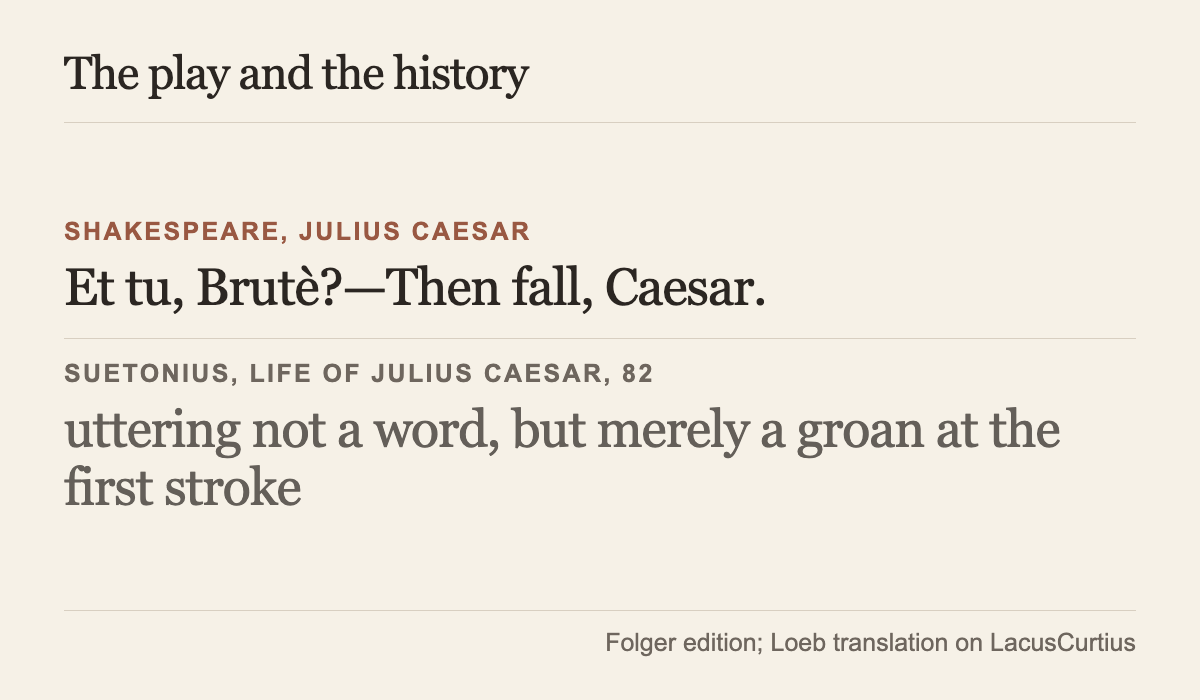
Et tu, Brutè?—Then fall, Caesar.
William Shakespeare, Julius Caesar, Act 3, Scene 1, line 85 in the Folger edition. The play dates from 1599. These are the last words Caesar speaks alive: the next thing in the text is his death. [1] [8]
Where it sits in the play
The conspirators have surrounded Caesar in the Capitol, and they are kneeling one after another to beg the return of the banished Publius Cimber. Brutus kneels too, and Caesar is startled: “What, Brutus?” He refuses them all. When Decius kneels, he snaps, “Doth not Brutus bootless kneel?” If Brutus cannot move him, nobody can. Then Casca cries “Speak, hands, for me!” and the knives come out. [1]
The line has two halves, and the second does the work. “Et tu, Brutè?” is recognition. “Then fall, Caesar” is a decision: this Caesar gives up once he sees who is among the killers. Shakespeare allows the moment no room. The next voice is Cinna’s, shouting “Liberty! Freedom! Tyranny is dead!” [1]
What the Roman writers report
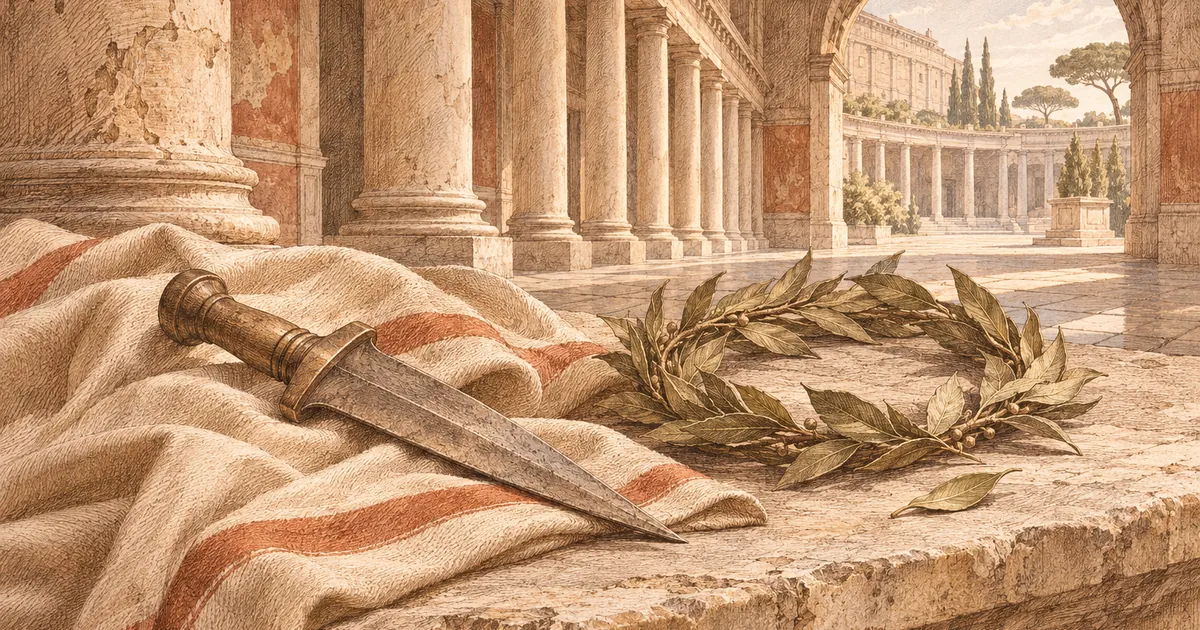
Suetonius says Caesar covered his head with his robe and “was stabbed with three and twenty wounds, uttering not a word, but merely a groan at the first stroke.” Then he adds a hedge: “some have written that when Marcus Brutus rushed at him, he said in Greek, ‘You too, my child?’” [2]
Cassius Dio has Caesar “unable to say or do anything,” and calls that “the truest account, though some have added that to Brutus, when he struck him a powerful blow, he said: ‘Thou, too, my son?’” [3] Plutarch gives him no words at all. Some writers, he says, told that when Caesar “saw that Brutus had drawn his dagger, he pulled his toga down over his head.” His life of Brutus has the same gesture: Caesar “covered his head with his robe, and resigned himself to the dagger-strokes.” [4] [5]
The classicist Ioannis Ziogas notes that the Greek version “was the less popular in the ancient sources.” He also reads it against the grain. In his argument the words are a prophecy more than a cry of pain: “You too, son, will die.” That is one scholar’s interpretation, and it shows how much is still open in a sentence of three words. [6]
Where the Latin came from
The tag was on the English stage before Julius Caesar. It appears in The True Tragedy of Richard Duke of York, printed in 1595, the text behind Henry VI, Part 3. There Edward says it to his brother Clarence, who has just declared for the other side: “Et tu Brute, wilt thou stab Cæsar too?” [7] [6]
How it is usually used
Today the phrase is shorthand for betrayal by someone close, often said half as a joke when a friend takes the other side. [8] That use is faithful to the play. What it drops is the distance between the play and the event: the words record what a dramatist imagined, about a killing the surviving accounts describe in other ways.
Should you still quote it?
Our view: yes, and give it to the right author. “As Shakespeare’s Caesar says” is accurate. “Caesar’s last words were” is more than anyone can claim. If you want the historical moment, the image in Plutarch is the stronger one: a man who stops fighting and covers his head.