Affirmation quotes are lines by real people that you can borrow and say to yourself. The 24 below include “I am” lines from Walt Whitman, Charlotte Brontë, Zora Neale Hurston and Audre Lorde. We checked each one against its source and added who said it, when, and what was happening at the time.
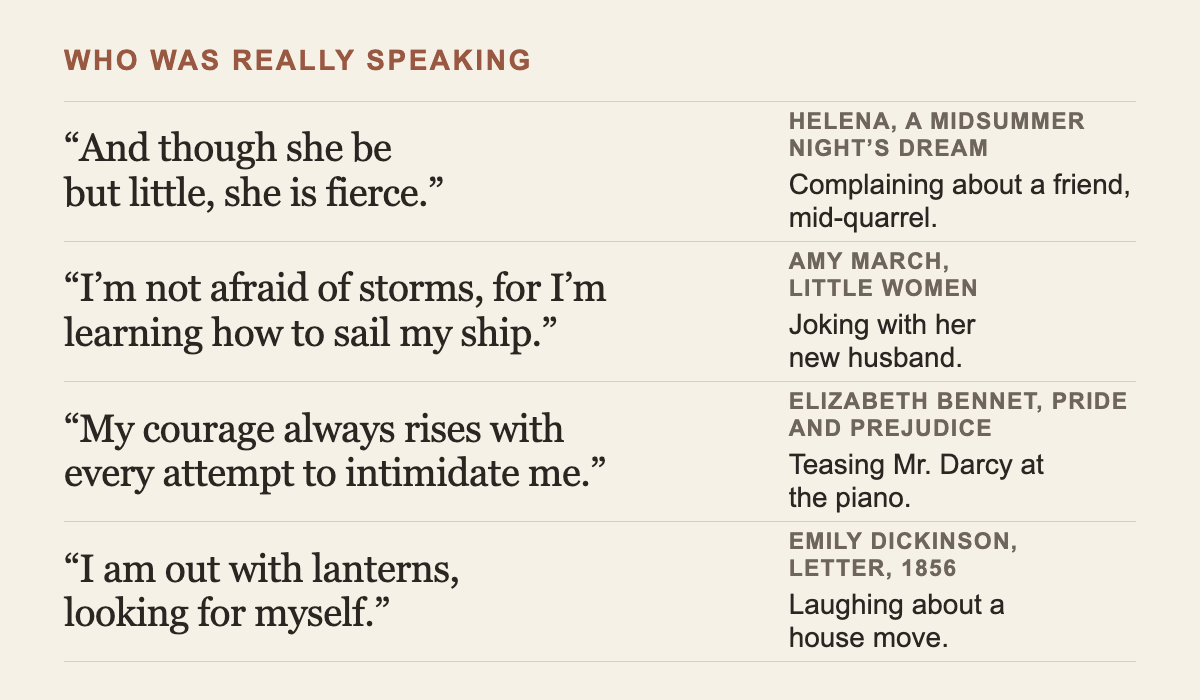
Few of them were written as affirmations. One began as an insult, one was a joke between newlyweds, and one went to a friend in the middle of a quarrel. Knowing that doesn’t spoil them. It tells you what you are really saying when you repeat them. For the difference between a quotation and a statement you write yourself, see Affirmations vs. Quotes.
How to use a real line as an affirmation
- Choose one you can say without wincing. If a line sounds like someone else’s boast, leave it and try another.
- Read the story first. A line can mean something different in its original place, and you can then decide whether you still want it.
- Keep the words and the name. If you change the wording, it becomes your sentence and should stop carrying theirs.
- Put it where you will see it. A note on the mirror, the first page of a notebook or your lock screen will do. Read it once and get on with your day.
This is a reading habit, and we make no promises about what it will do for you. What studies have and have not found is covered in Do Affirmations Work?
“I am” quotes about who you are
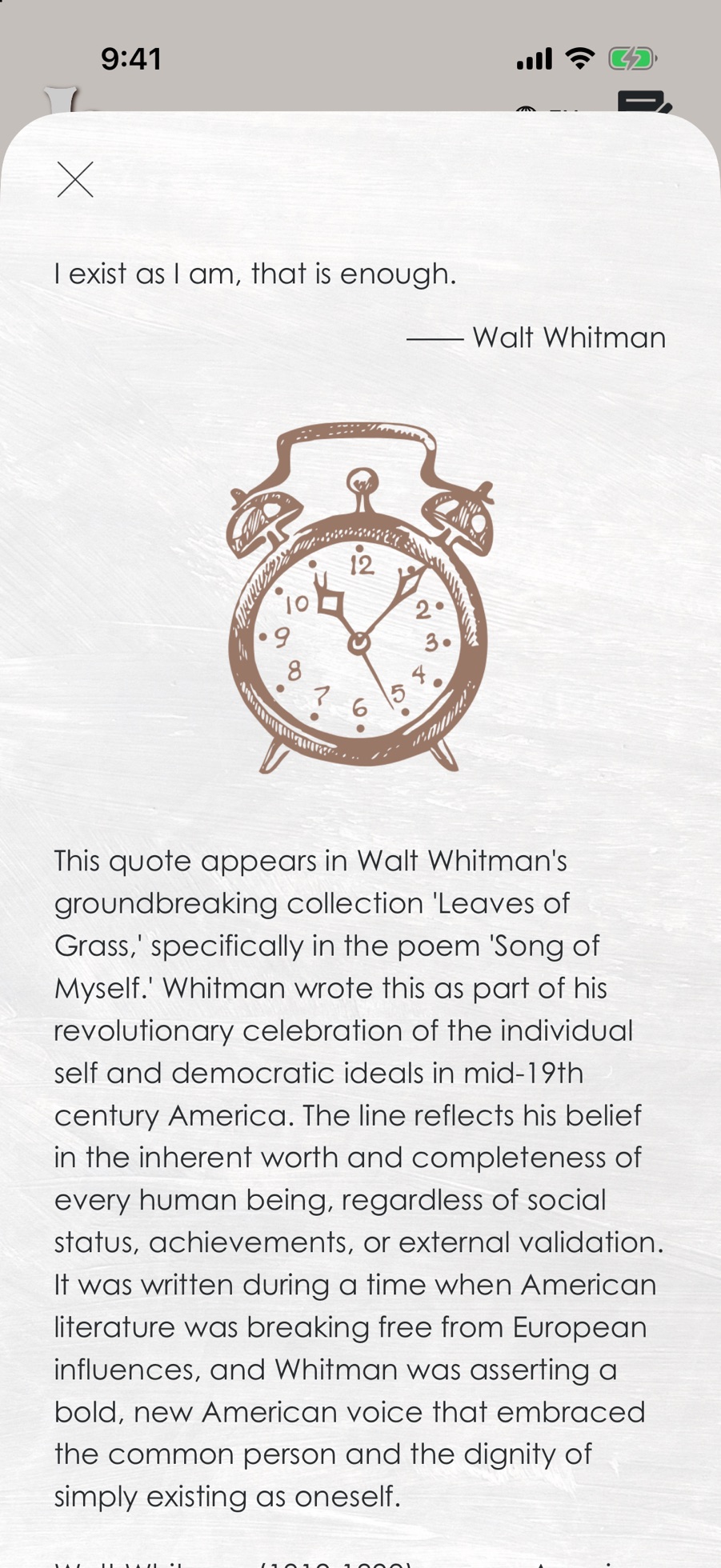
I exist as I am, that is enough
Walt Whitman, “Song of Myself,” section 20, Leaves of Grass (1891–92 edition). Whitman published the first edition himself in 1855 and was still revising the book in his last years. [1] The next lines say he sits content whether or not anyone in the world is aware of him. [2]
Do I contradict myself?
Very well then I contradict myself,
(I am large, I contain multitudes.)
Walt Whitman, “Song of Myself,” section 51. This comes near the end of the poem, as the speaker turns to the reader with evening coming on. In this edition he put the famous part in parentheses, as if it were an aside. [2]
I took a deep breath and listened to the old brag of my heart. I am, I am, I am.
Sylvia Plath, The Bell Jar (1963). Near the end of the novel, Esther Greenwood remembers the funeral of Joan Gilling. Esther is recovering from a breakdown, and her heartbeat gives her one plain fact to hold: she is alive. [3]
I am a woman’s rights.
Sojourner Truth, speech at the Woman’s Rights Convention, Akron, Ohio (1851). Truth was born into slavery. [4] These words come from Marius Robinson, who was in the audience and printed the speech weeks later. The famous “Ar’n’t I a woman?” wording comes from a version Frances Gage published nearly 12 years afterward. [5]
But I am not tragically colored. There is no great sorrow dammed up in my soul, nor lurking behind my eyes.
Zora Neale Hurston, “How It Feels to Be Colored Me,” The World Tomorrow (1928). Hurston dates her sense of race to age 13, when she left the Black town of Eatonville, Florida, for school in Jacksonville. She turns down pity in the same essay: “I do not weep at the world—I am too busy sharpening my oyster knife.” [6] [7]
I am the dream and the hope of the slave.
Maya Angelou, “Still I Rise,” And Still I Rise (1978). The line arrives at the close of the poem, just before the last three “I rise” refrains. Having answered everyone who wants to see her broken, the speaker names what she carries from her ancestors. [8]
I am rooted, but I flow.
Virginia Woolf, The Waves (1931). Jinny thinks this as she walks into a party, enjoying being looked at and ready for whoever comes toward her. The novel follows six friends through their lives, in their own voices.
Self-affirmation quotes for standing your ground
I am the master of my fate:
I am the captain of my soul.
William Ernest Henley, “Invictus,” written 1875, published 1888. Henley lost his left leg below the knee to tuberculosis at 16. He wrote these verses while recovering in an Edinburgh infirmary, after the surgeon Joseph Lister saved his other leg. [9] [10]
I am no bird; and no net ensnares me; I am a free human being with an independent will, which I now exert to leave you.
Charlotte Brontë, Jane Eyre (1847), chapter 23. Jane says this to Mr. Rochester, who has just called her a “wild frantic bird.” Most quotations stop at “independent will.” The sentence goes on to say what she will do with it. [11]
I care for myself. The more solitary, the more friendless, the more unsustained I am, the more I will respect myself.
Charlotte Brontë, Jane Eyre, chapter 27. After learning that Rochester already has a wife, Jane argues with herself about staying. A voice inside asks who in the world cares for her, and this is her answer. Brontë put the first word in italics. [11]
My courage always rises with every attempt to intimidate me.
Jane Austen, Pride and Prejudice (1813), chapter 31. Elizabeth Bennet is at the piano at Rosings when Mr. Darcy comes over to listen. She is teasing him, and she opens with “You mean to frighten me, Mr. Darcy, by coming in all this state to hear me.” [12]
And though she be but little, she is fierce.
William Shakespeare, A Midsummer Night’s Dream (about 1595), Act 3, Scene 2. On a mug this is a compliment. On stage it is a complaint: Helena is describing her childhood friend Hermia in the middle of a four-way quarrel, right after saying “She was a vixen when she went to school.” [13]
I am not free while any woman is unfree, even when her shackles are very different from my own.
Audre Lorde, “The Uses of Anger: Women Responding to Racism” (1981). Lorde gave this keynote at the National Women’s Studies Association conference in Storrs, Connecticut. The sentence ties her freedom to other people’s, which is unusual for a line used as an affirmation. [14]
All the knowledge I possess every one else can acquire, but my heart is exclusively my own.
Johann Wolfgang von Goethe, The Sorrows of Young Werther (1774), translated by R. Dillon Boylan. Werther writes this about a prince who values his intellect and talents above his feelings. The heart he is so proud of is also what undoes him by the end of the novel. [15]
Positive affirmation quotes for when you are still learning
I’m not afraid of storms, for I’m learning how to sail my ship.
Louisa May Alcott, Little Women (1868–69), chapter 44. Amy March says this, and it is lighter than it looks on a poster. Newly married, she is answering Laurie’s joke about her keeping him pointed due west like a weathercock. Then she offers to go and find his bootjack. [16]

I am always doing what I can’t do yet in order to learn how to do it.
Vincent van Gogh, letter to Anthon van Rappard (August 1885), translated by Johanna van Gogh-Bonger, edited by Robert Harrison. Van Gogh wrote this to a fellow painter who had called his work weak. A few lines earlier he says, “Well, I won’t accept this - never.” [17]
I am looking, I am hunting for it, I am deeply involved.
Vincent van Gogh, letter to Theo van Gogh (May 1882), same translation. After a break with the painter Anton Mauve, van Gogh explains what he meant by calling himself an artist: looking for something without ever fully finding it. You may see this online as “I am seeking, I am striving, I am in it with all my heart,” which is not the wording of this translation. [18]
Life for me ain’t been no crystal stair.
Langston Hughes, “Mother to Son,” The Crisis (December 1922). A mother is speaking to her son. She describes a staircase with tacks, splinters and torn-up boards, tells him not to sit down on the steps, and says she is still climbing. [19]
Such as are thy habitual thoughts, such also will be the character of thy mind; for the soul is dyed by the thoughts.
Marcus Aurelius, Meditations (second century CE), Book 5, section 16, translated by George Long. The Roman emperor wrote the Meditations to and for himself, [20] so this is one of the few lines here that really was self-instruction. The next sentence tells him to dye his soul with better thoughts. [21]
I tell you: one must still have chaos in one, to give birth to a dancing star.
Friedrich Nietzsche, Thus Spake Zarathustra (1883), Prologue, section 5, translated by Thomas Common. Zarathustra says this to a crowd in a marketplace, warning them about the “last man,” who wants only comfort. The crowd shouts back that it would like to be exactly that. [22]
Quiet affirmation quotes for finding your way back
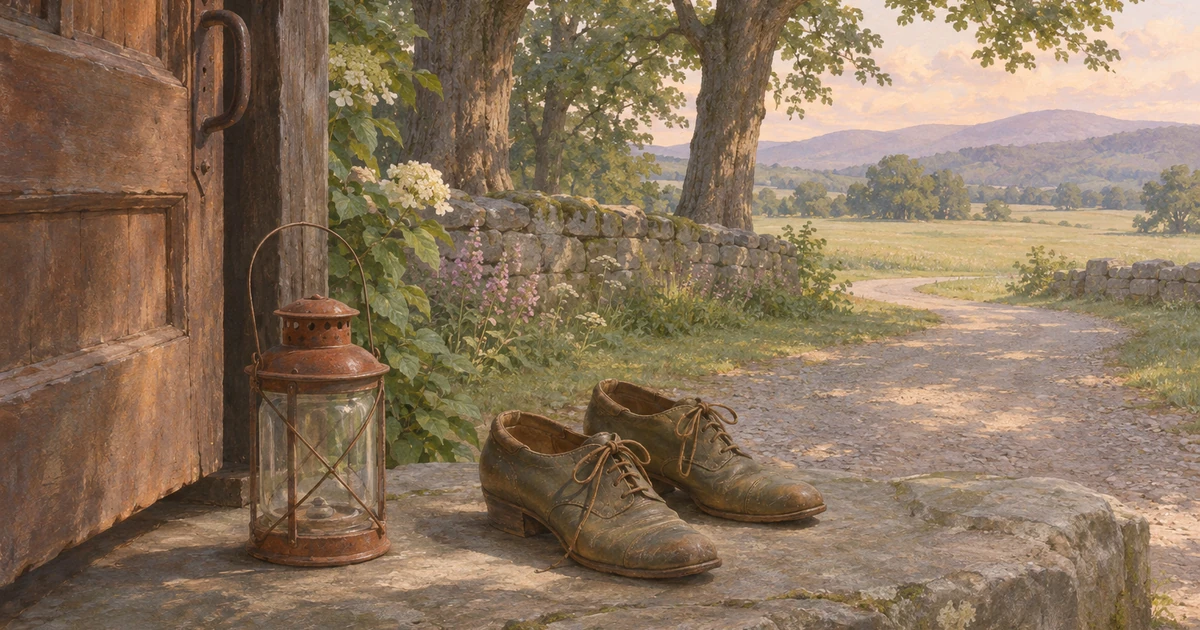
I am out with lanterns, looking for myself.
Emily Dickinson, letter to Elizabeth Holland (about January 1856). Dickinson had just moved back to the family Homestead, somewhat reluctantly. [23] She jokes that she made a list of her senses, her hat, her coat and her best shoes, lost it in the confusion, and now has to go and find herself. [24] [25]
Not knowing when the dawn will come
I open every door;
Emily Dickinson, “Dawn,” Poems, Third Series (1896). This was printed ten years after her death. The poem goes on to wonder whether the dawn has feathers like a bird or billows like a shore. [26]
Nothing can bring you peace but yourself.
Ralph Waldo Emerson, “Self-Reliance,” Essays: First Series (1841). This is the second-to-last sentence of the essay, after a warning not to trust good luck such as a rise in rents or a friend’s return. The last sentence says what he means: “Nothing can bring you peace but the triumph of principles.” [27]
Where the mind is without fear and the head is held high;
Rabindranath Tagore, Gitanjali (English edition, 1912), poem 35. It is usually quoted alone, but it opens a prayer. The poem runs through a list of “where” lines and ends, “Into that heaven of freedom, my Father, let my country awake.” [28] The English version, Tagore’s own, appeared the year before his Nobel Prize. [29]