
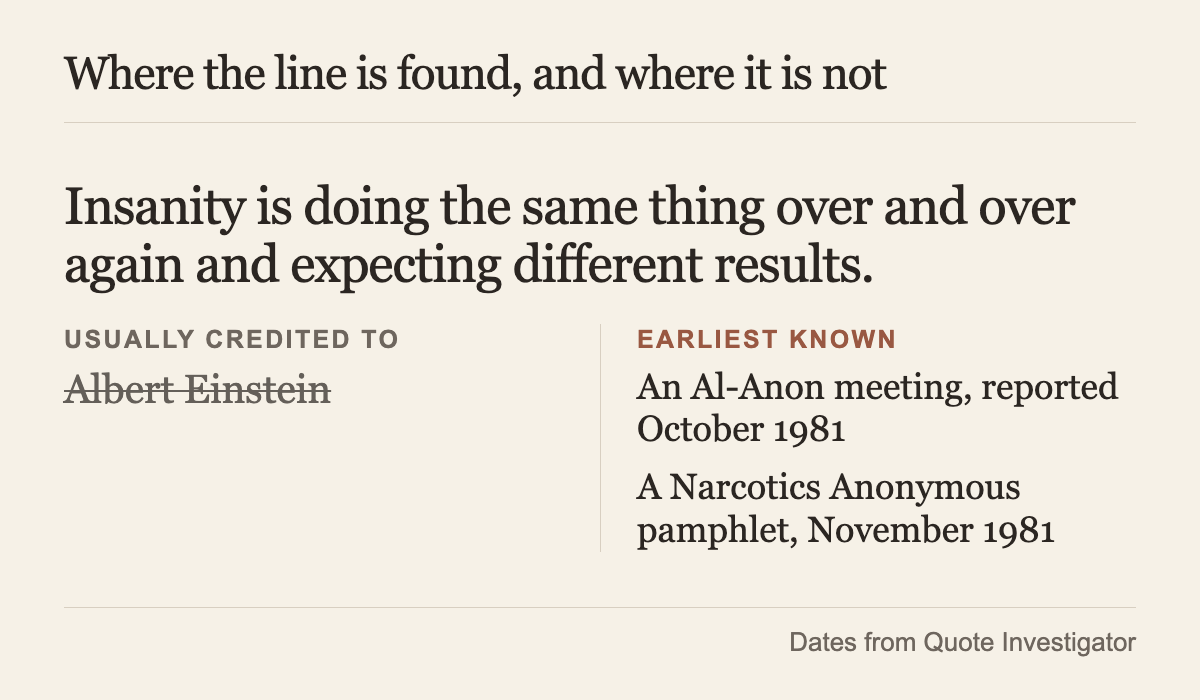
“Insanity is doing the same thing over and over again and expecting different results” is credited to Albert Einstein almost everywhere, and there is no evidence he said it. The earliest known appearances are from 1981, in twelve-step recovery groups, where it was a plain piece of advice about addiction. [1]
The line, exactly
Insanity is doing the same thing over and over again and expecting different results.
As reported in a Knoxville, Tennessee newspaper in October 1981, said by a woman at an Al-Anon meeting. This is the earliest strong match Quote Investigator has found. [1]
Where it was said
Al-Anon is for the families of alcoholics, and its meetings work through twelve steps. The second speaks of a power that “could restore us to sanity.” The reporter describes one woman at the meeting objecting: she had never been insane. Another answers her with the line. In that room it is a working definition for the purposes of the step. Nobody is offering a diagnosis. [1]
A month later a Narcotics Anonymous pamphlet printed a close variant: “Insanity is repeating the same mistakes and expecting different results.” Quote Investigator concludes that the saying began somewhere in the twelve-step communities, and that because those communities value anonymity, no author has been identified. [1]

How Einstein got attached
Not through anything he wrote. Quote Investigator reports that the line is listed under “Misattributed to Einstein” in The Ultimate Quotable Einstein, the reference published by Princeton University Press, and that the link to him came many years after his death. In 1983 the novelist Rita Mae Brown gave the line to a character in Sudden Death, and it is sometimes credited to her as well. [1]
What it means there
In recovery the sentence has a precise target: the drinker or user who believes this time will be different, and the relative who keeps trying the same rescue. It names a pattern the person in the room already recognises. It is said by people who have done it, to people who are doing it.
How it is usually used
Outside those rooms it has become a line for business books and political speeches, with Einstein’s face beside it, meaning roughly: try something new. Two things get lost. The first is the source, which was a group of anonymous people helping each other. The second is care with the word. It was never a definition of mental illness, and repeating an attempt is sometimes just practice.
Should you still quote it?
Our view: yes, as a saying from the recovery movement. It is stronger that way. A proverb earned by people breaking a habit carries more weight than a remark invented for a physicist.