
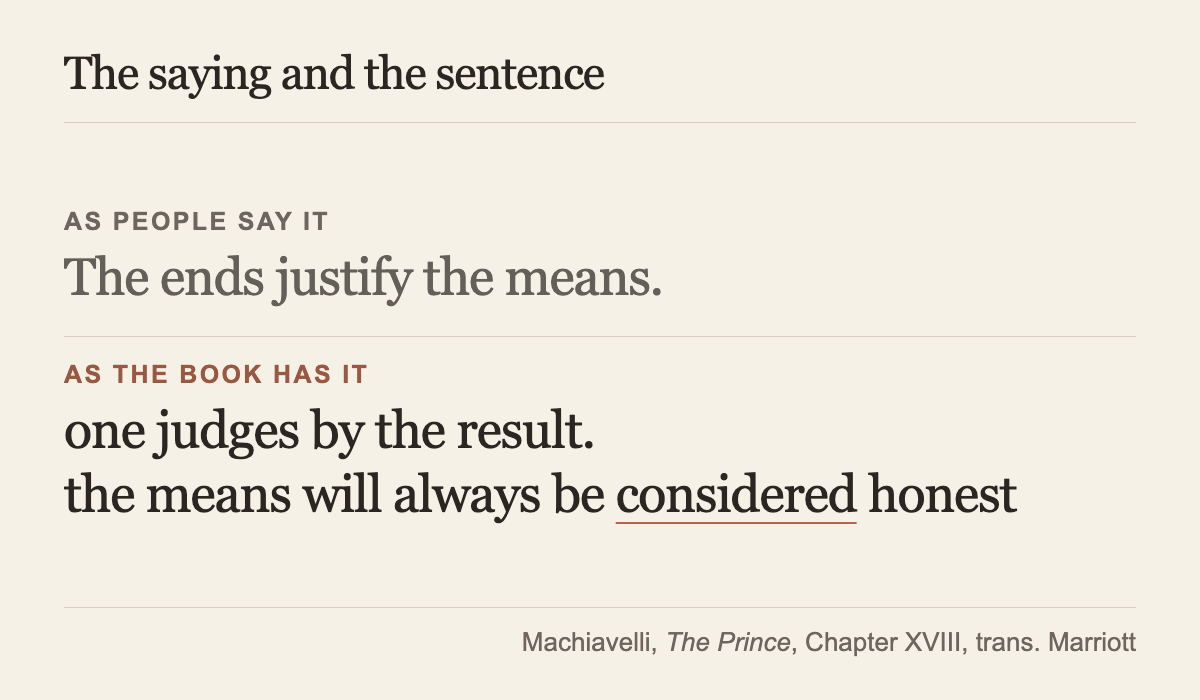
“The ends justify the means” is treated as Machiavelli’s motto, but the sentence does not appear in The Prince. The passage it is drawn from says something narrower: that in judging the actions of princes, “one judges by the result.” He is describing how people judge. [1]
The line, exactly
…in the actions of all men, and especially of princes, which it is not prudent to challenge, one judges by the result. For that reason, let a prince have the credit of conquering and holding his state, the means will always be considered honest, and he will be praised by everybody; because the vulgar are always taken by what a thing seems to be and by what comes of it…
Niccolò Machiavelli, The Prince, Chapter XVIII, in W. K. Marriott’s translation. We searched this translation for the familiar sentence and for the word “justify” used in that sense, and found neither. [1]
Where it sits in the book
The chapter is about whether rulers should keep their word. Its advice is that a prince must appear to have five qualities, to seem “altogether merciful, faithful, humane, upright, and religious,” whether or not he has them. The reason given is about the audience: “men judge generally more by the eye than by the hand,” and “Every one sees what you appear to be, few really know what you are.” [1]

The famous passage follows from that. Because nobody can safely question a prince, people fall back on outcomes. If he wins and holds the state, “the means will always be considered honest.” The word is “considered.” Machiavelli is predicting the verdict of the crowd, which is “always taken by what a thing seems to be and by what comes of it.” [1]
What it means there
Two things separate this from the slogan. First, it is an observation: this is how reputations are made. It is cynical, but it is a claim about what happens, and the reader is free to dislike it. Second, the end in question is specific. Machiavelli is talking about winning and holding a state. He is not handing a general rule to anyone with a goal.
None of this makes the book gentle. The same chapter tells rulers when to break their promises. But the tidy universal maxim, any end, any means, is a later summary of his reputation.
How it is usually used
The phrase is quoted in arguments about politics, business and sport, sometimes as an accusation and sometimes as a boast, and Machiavelli’s name is added to give it a pedigree. That turns a description of public opinion into a principle of action, and makes an author who wrote about one particular job sound as if he were advising everyone.
Should you still quote it?
Our view: quote it as a saying, and leave him out. If you want Machiavelli, the real sentences are sharper: “Every one sees what you appear to be, few really know what you are.” That one is in the book.