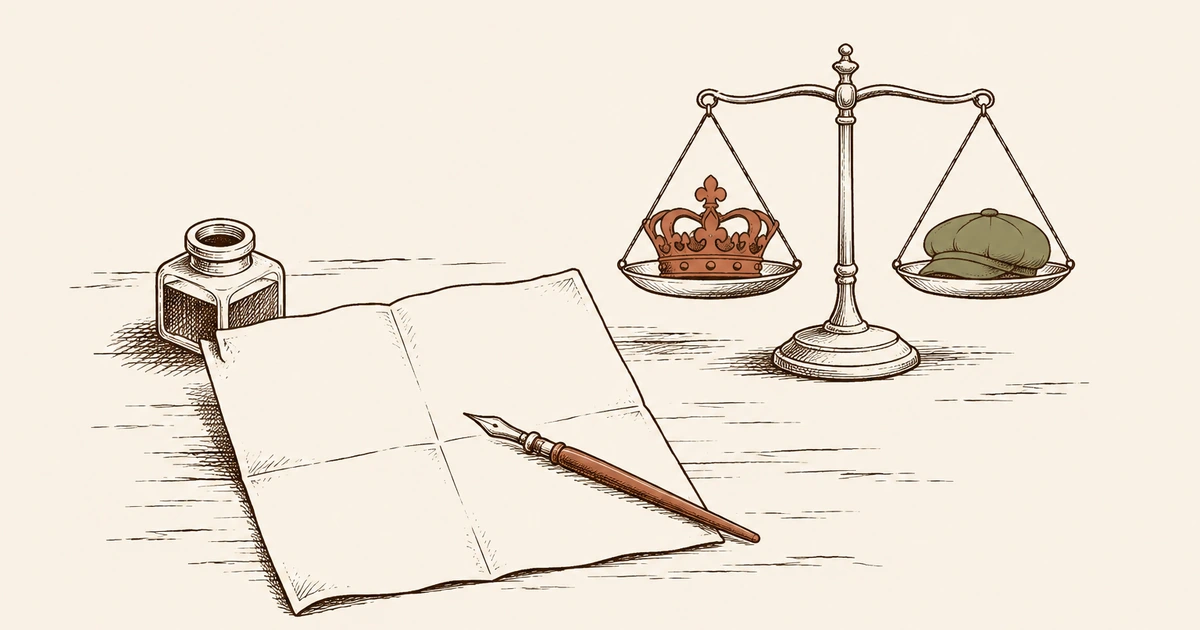
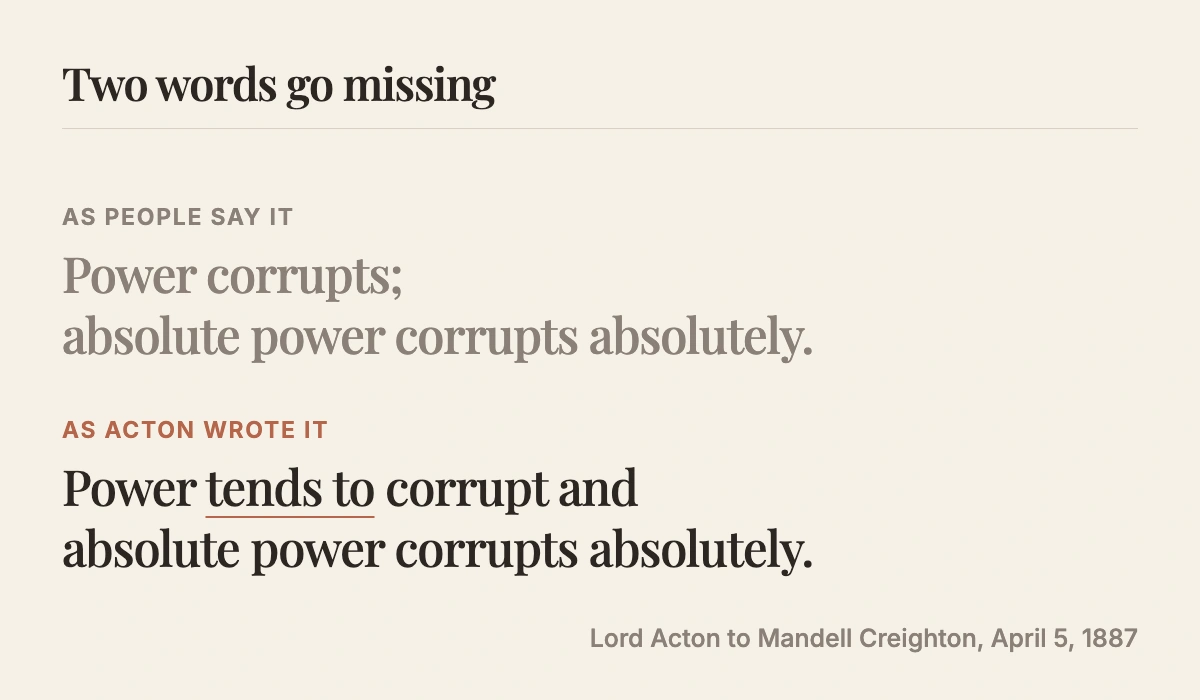
“Power corrupts; absolute power corrupts absolutely” is a tidied-up version. Lord Acton wrote “Power tends to corrupt and absolute power corrupts absolutely,” in a private letter of 1887. He was arguing about how history should be written: the powerful must not be let off more lightly than anyone else. [1]
The line, exactly
Power tends to corrupt and absolute power corrupts absolutely. Great men are almost always bad men, even when they exercise influence and not authority: still more when you superadd the tendency or the certainty of corruption by authority.
John Emerich Edward Dalberg-Acton, Lord Acton, in a letter to Mandell Creighton dated April 5, 1887. [1] [2]
What the letter was about
Mandell Creighton, a Church of England clergyman and historian, had written a history of the popes. Acton, a Catholic and a historian himself, thought Creighton had been far too gentle with popes who were responsible for persecution. Their exchange of letters is about the moral problem of writing the history of the Inquisition. [1]
The sentence just before the famous one states the disagreement: “I cannot accept your canon that we are to judge Pope and King unlike other men, with a favourable presumption that they did no wrong. If there is any presumption it is the other way against holders of power, increasing as the power increases.” Because rulers escape the law in their lifetimes, he adds, “Historic responsibility has to make up for the want of legal responsibility.” [1]
What it means there
The line is Acton’s reason for a rule of method. Do not assume the great acted well; lean the other way. A little further on he gives the rule its sharpest form: “There is no worse heresy than that the office sanctifies the holder of it.” [1]
So the remark is aimed at admirers of power as much as at its holders: at the biographer, the historian and the citizen who are inclined to excuse a crime because of who committed it.
“Tends to”
The two words usually dropped are doing careful work. Acton does not say power always corrupts. He says it pulls that way, and that the pull grows with the power. Only at the extreme does he drop the hedge: “absolute power corrupts absolutely.” The popular version makes the first half as flat as the second and turns a tendency into a law.
How it is usually used
The short form is brought out when a politician or an executive is caught, as a comment on what office does to a person. That is fair to half of Acton’s thought. The half that is lost is the instruction to the rest of us: do not give the powerful the benefit of the doubt.
Should you still quote it?
Our view: yes, with “tends to,” and with the sentence after it if there is room. “Great men are almost always bad men” is the uncomfortable part, and the reason the letter is still read.