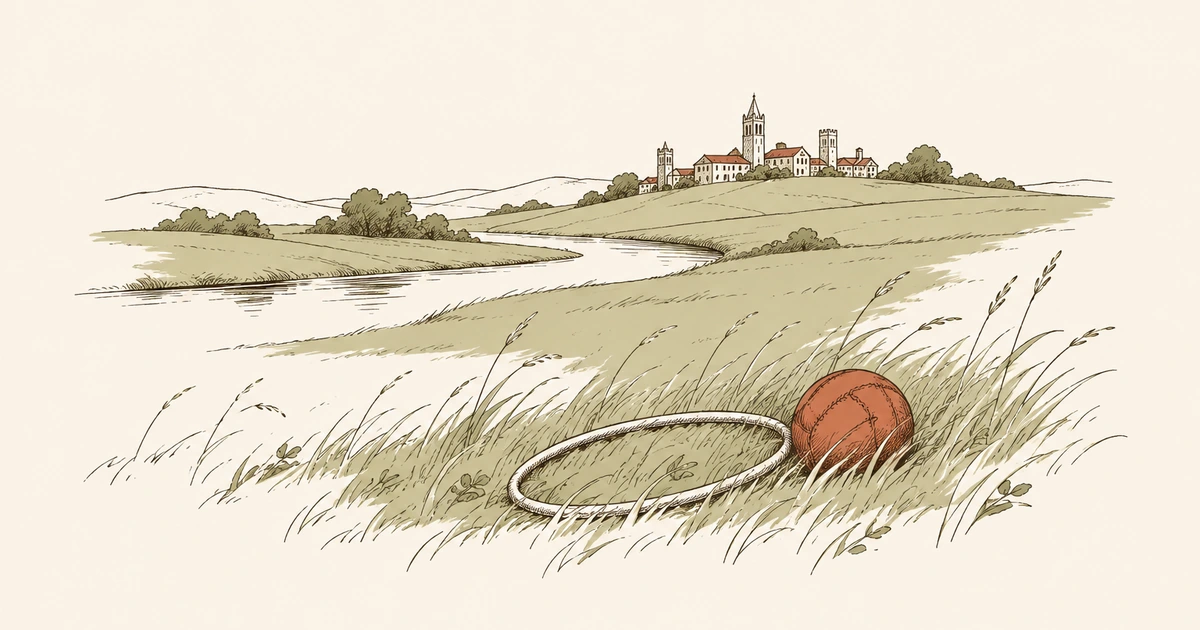
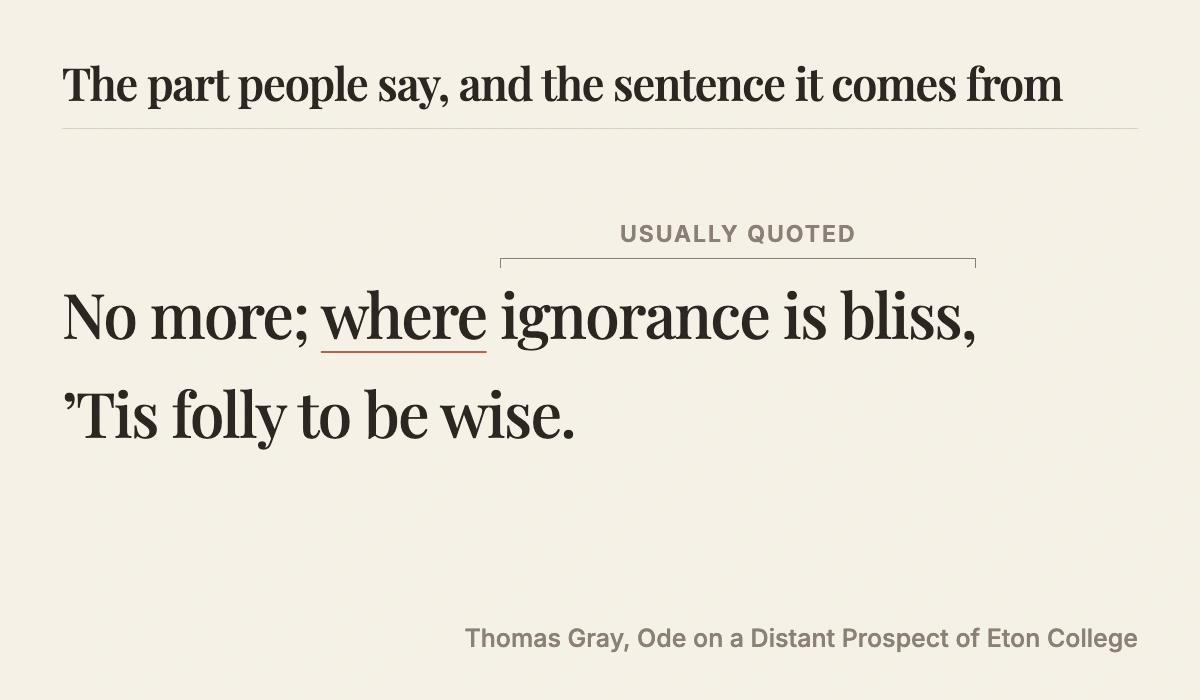
“Ignorance is bliss” is the middle of a longer sentence. Thomas Gray wrote “where ignorance is bliss, / ’Tis folly to be wise,” at the end of a poem about watching schoolboys play. He is talking about children who do not yet know the troubles ahead of them, and asking why anyone should tell them. [1]
The line, exactly
Yet ah! why should they know their fate?
Since sorrow never comes too late,
And happiness too swiftly flies.
Thought would destroy their paradise.
No more; where ignorance is bliss,
’Tis folly to be wise.
Thomas Gray, “Ode on a Distant Prospect of Eton College,” the last six lines. Gray wrote the poem in August 1742 and published it, without his name, in 1747. It was the first of his English poems to appear in print. [1]
What happens in the poem
The speaker looks at Eton College from a distance. Gray had been a pupil there. He watches the boys at their games on the bank of the Thames, and the sight sets him thinking about what they do not know. “Alas, regardless of their doom, / The little victims play! / No sense have they of ills to come, / Nor care beyond today.” [1]
The middle of the poem is a list of what waits for them as adults: anger, fear, jealousy, poverty, illness, age. Then the tone turns. “To each his sufferings: all are men, / Condemned alike to groan.” Since all of it is coming anyway, the speaker decides to say nothing. That is where the famous line arrives. [1]
What it means there
The word that matters is “where.” Gray does not claim that not knowing is good. He says that in one particular place, a childhood that will end soon enough, knowledge would only spoil the time that is left. It is a statement of pity from an adult who cannot go back.
It is also sad more than it is comfortable. The speaker knows; that is his condition. The bliss belongs to someone else.
How it is usually used
On its own, “ignorance is bliss” is said with a shrug, to excuse not reading the news, not checking a bank balance, not asking a hard question. It is also used as a sneer at people who do not know better. Both uses drop the condition, and both drop the children.
Should you still quote it?
Our view: yes, with the “where.” The honest use is narrow: there are moments when telling someone a painful truth early gives them nothing but a longer sorrow. Gray is not offering a rule for living.