“Give me liberty, or give me death” is one of the most famous sentences of the American Revolution, and nobody wrote it down when it was spoken. Patrick Henry addressed the Virginia convention in Richmond on March 23, 1775. The speech we read today was published more than forty years later by his biographer, William Wirt, who worked from what aging witnesses remembered. [1] [2]
The line, exactly
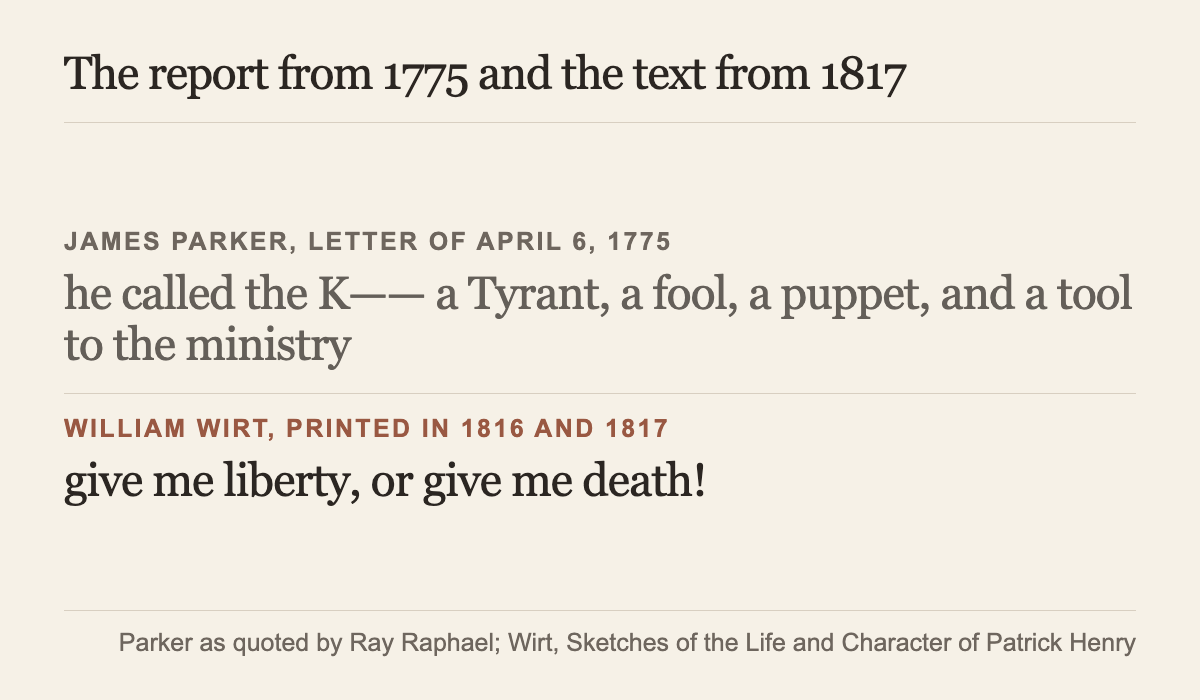
“I know not what course others may take; but as for me,” cried he, with both his arms extended aloft, his brows knit, every feature marked with the resolute purpose of his soul, and his voice swelled to its boldest note of exclamation, “give me liberty, or give me death!”
William Wirt, Sketches of the Life and Character of Patrick Henry (1817). Wirt had already released the speech as a sample in Port Folio magazine in 1816, forty-one years after the day. [1] [2]
Where it sits
The Second Virginia Convention met at St. John’s Church in Richmond from March 20, 1775. Henry, a delegate from Hanover County, offered amendments to raise a militia independent of royal authority, worded in a way that treated war with Britain as inevitable. Moderates objected, and on March 23 he rose to defend them. [3]

Wirt’s version ends with a piece of theatre to match. “He took his seat. No murmur of applause was heard. The effect was too deep.” [1]
How the speech was put together
Wirt began his biography in 1805, a few years after Henry’s death. He had neither met Henry nor heard him speak, and the material was thin. By 1815 he was complaining that for the years from 1763 to 1789, “not one of his speeches lives in print, writing or memory.” [2]
For this speech he turned to Judge St. George Tucker, who sent his recollections with a warning: “In vain should I attempt to give any idea of his speech.” Tucker’s passage is less than one-fifth of what Wirt printed, though Wirt told him, “I have taken almost entirely Mr. Henry’s speech in the Convention of ’75 from you.” Ray Raphael’s count is blunt: “More than one thousand of the 1,217 words” came from Wirt, the ending included. [2]
One report does survive from that spring, and it sounds nothing like the book. In a letter of April 6, 1775, James Parker, a Scottish merchant in Virginia and no admirer of Henry’s, wrote that he “called the K—— a Tyrant, a fool, a puppet, and a tool to the ministry.” [2]
What historians make of it
Scholars question how much of the speech belongs to Wirt or Tucker, and it is possible Henry never spoke the famous words. Others stress what survives anyway. The historian Bernard Mayo, while noting the general skepticism, wrote that “its spirit is that of the fiery orator.” [3]
The phrase itself was available to him. Raphael calls “liberty or death” “common currency”: Christopher Gadsden had used a Latin form a decade earlier, and Addison’s play Cato (1713) has the line “But chains or conquest, liberty or death.” [2] [3] Henry could have said it. Nobody can show that he did.
How it is usually used
The sentence has become the standard example of American defiance, and students are still taught to pair it with Henry. Raphael’s objection goes beyond credit. The polished speech, he argues, hides a rougher Revolution, one with name-calling in it, of the kind Parker describes. [2]
Should you still quote it?
Our view: yes, with a small change of phrasing. “Patrick Henry is remembered as saying” is honest and costs nothing. “In William Wirt’s telling” is better still, because the sentence is a fine piece of writing and its likely author rarely gets the credit.