

Start with the kind of reading you want
An affirmation is something you affirm; a quotation is someone else’s words that you reproduce with attribution. In everyday use, “affirmation” often means an encouraging statement about yourself. In research, self-affirmation can instead mean reflecting on a personally important value. Those are different activities. [1] [2]
A useful way to choose is to ask whether you want to speak in your own voice, explore what matters to you, or consider another person’s perspective. You can enjoy more than one form. This guide is about that choice; our research overview on affirmations addresses evidence and effects.
Luminora sits on the quotation side of this choice, so here is what that means in practice. You read real words from real people, and on literary quotes in LEARN, Context shows who said the line, what was happening and why. In SEEK you can ask a question and get a quote that fits it, with Context on the other side of every card. If you came here because affirmations feel like something you have to talk yourself into, that is the difference: nothing asks you to claim the line as your own.
Affirmations, values reflections, and quotations
A positive self-statement puts you in the sentence
A positive self-statement asserts a favorable quality, possibility, or attitude about yourself. An original example is: “I can make a thoughtful contribution.” You might say it aloud, write it down, or keep it where you will see it. Those are possible uses, not a required formula. The statement asks you to consider it as true of yourself.
A values reflection asks what matters and why
Values reflection makes room for explanation. An original prompt is: “What does being dependable mean to me, and when have I tried to live that way?” You might respond with a memory or a few sentences. The activity is the reflection, rather than the mere presence of an encouraging phrase. Research exercises often ask people to elaborate on an important value. [1]
A quotation brings another voice into the room
A quotation preserves someone else’s wording and identifies its source. It may offer an observation, a question, an image, or a claim you disagree with. Reading it does not require you to announce that it describes your life. The author, work, and surrounding passage can matter as much as the isolated line.
Grammar does not settle the distinction. A quotation can begin with “I,” and a self-statement can borrow a verified quotation. If you change a writer’s wording into your own first-person sentence, label your version as an adaptation or personal reflection. Do not keep quotation marks and the original author’s name around words they did not write.
One situation, three ways to approach it
Suppose you are about to begin a task you have been avoiding. The following lines are original examples written by the Luminora Team. They are not historical quotations, app outputs, participant statements, or tested interventions.
- Self-statement: “I can give this task my attention, one piece at a time.” This speaks directly about your capacity to act.
- Values prompt: “What part of this task connects with something I care about?” This asks you to supply the meaning.
- Reflective reading line: “A beginning can be smaller than the story we tell about it.” This is an original sentence to consider, not a quotation attributed to a famous writer.
You might prefer the directness of the first, the open question in the second, or the room for interpretation in the third. None is a promise that the task will become easy. The distinction helps you notice the kind of language you want before selecting a book, a note, or an app.
After a conversation that did not go as you hoped
Here is a second set of original Luminora Team examples. Notice how the purpose changes even though the situation stays the same.
- Self-statement: “I can acknowledge a mistake and decide what to say next.”
- Values prompt: “What would respect look like in my next response?”
- Reflective reading line: “A conversation can leave a question worth returning to.”
A reader could disagree with a line, decide that the situation calls for a boundary rather than another conversation, or choose no sentence at all. You remain the person interpreting your circumstances. Words are a starting point for attention, not instructions that override your judgment.
Choose by preference, then check the fit
- If you want a direct reminder: try a short statement you can say in your own voice. Read it once and notice whether you agree with what it claims.
- If you want to understand your priorities: use a values question and leave space for an answer. An unfinished paragraph is still a reflection.
- If you want perspective or literary language: read a sourced quotation or a clearly labeled original reflection. You can respond with curiosity instead of agreement.
- If a sentence feels too sweeping: make your own version more specific, choose another line, or leave it alone. For example, our original “I can ask for clarification” makes a narrower claim than “I always know what to do.”
These are editorial suggestions for choosing language, not evidence that one form is more effective or safer for everyone. “I like reading this” and “this activity causes a measurable benefit” are different claims. For the latter, the research article explains the study designs and their limitations.
Before you keep a quotation, check its source
A familiar name under a beautiful sentence is not enough to establish authorship. When a line matters to you—or you plan to share it—try this short check:
- Find the original work. Look for a book, poem, essay, letter, speech, interview, or reliable edition that contains the wording.
- Read the surrounding passage. Check who is speaking and whether the sentence was shortened in a way that changes its meaning.
- Separate quotation from translation and paraphrase. Record the translator or edition when available. A summary in your own words should be labeled as a paraphrase.
- Keep uncertainty visible. If the attribution cannot be verified, do not promote it into a confident author credit. You can simply choose a better-sourced passage.
This article uses only our own examples, so no famous person is being made to endorse them. If you write a response to a real quotation, keep that response separate from the quoted text. A useful note can include the line, its source, and what you thought about it.
Some apps do part of this check for you. In Luminora, a literary quote in LEARN has a Context button: it opens the source of the line, a short note on what was happening when it was said, and a brief biography of the author. Every SEEK answer includes Context on the other side of the card, with the author and a short biography. Treat it as a starting point for the steps above, not a replacement for reading the original work. See a real example of Context. [4]

A small read, respond, and keep practice
Try this when you want a brief reading pause. It is an editorial suggestion, with no fixed frequency or promised outcome.
- Read one line. Choose a verified quotation or a clearly labeled original sentence. You do not need a whole collection at once.
- Add your response. Ask, “What do I agree with?” or “Where does this stop fitting my situation?” Your answer may belong in a private notebook rather than in an app.
- Keep it only if you want to return. Save the source with the words when possible. Revisiting is optional; you can also decide that the line has served its purpose.
A quotation can lead to a values reflection. A values reflection can lead to a sentence in your own voice. Keep the labels honest as you move between them, and avoid treating a reading preference as a measure of how well you are doing.
Reading, SEEK, and saving in Luminora
Luminora’s official description includes quote reading, SEEK responses that pair a relevant quote with a reflection, and LEARN favorites and collections. That makes it an option if you want to discover and revisit words. These are verified product descriptions, not a claim that the reading practice above was tested in the app. [3]
If a first-person statement feels like something you cannot honestly say, a quotation asks less of you. Someone else said it, in a particular situation, and you can read it without claiming it as your own. Luminora leans this way. In LEARN, literary quotes come with Context. In SEEK, the other side of every card gives you the story behind the quote, its author and a short biography. This describes a reading form you may prefer, not a measured effect. [4]
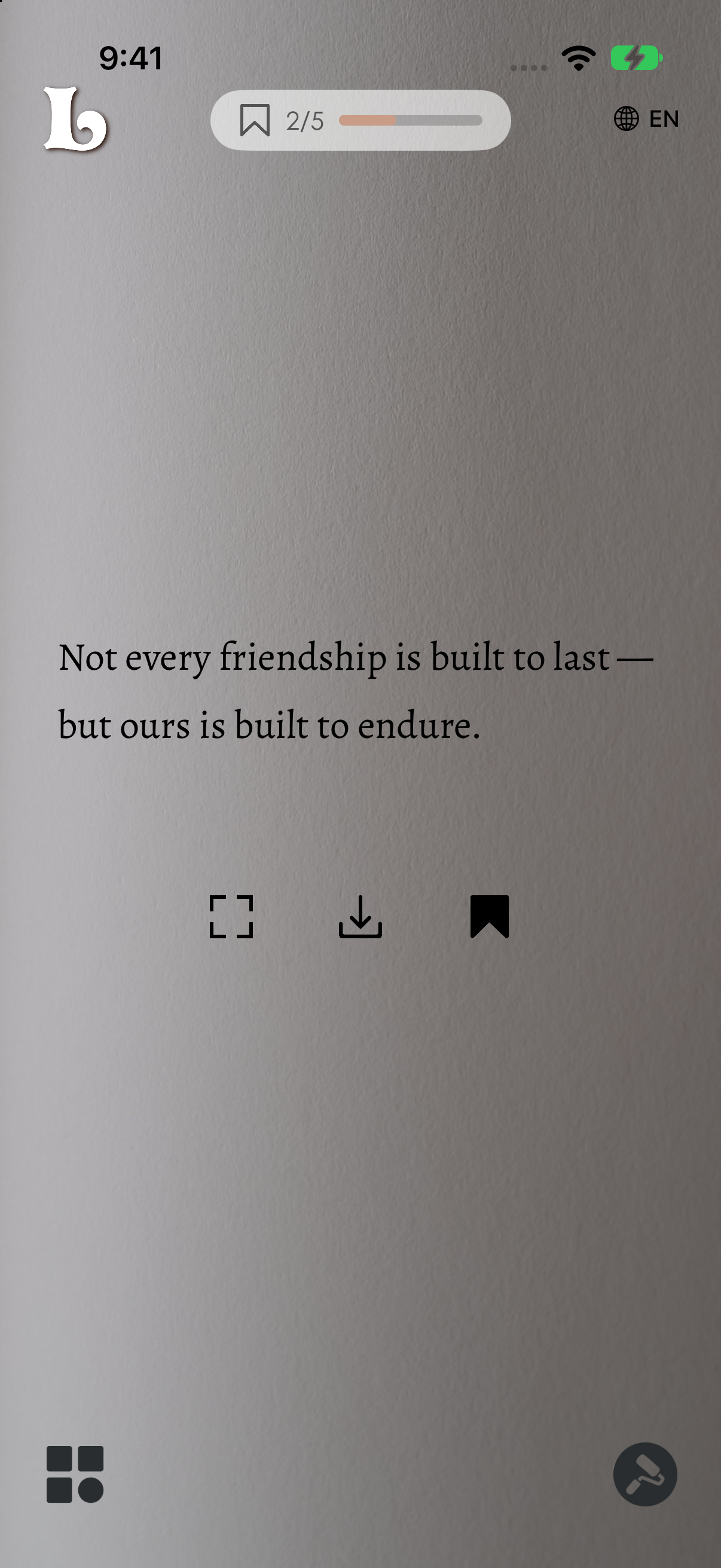
Choose a practical next step: follow the SEEK walkthrough if you want a question to lead the reading, compare a saved passage with the English–Spanish routine, or use the iPhone widget guide to keep a quote on your Home Screen. If you are comparing apps, start with our guide to the best affirmation apps.
A task you can try is to read a quote, ask SEEK a question about an everyday situation, and save a quote you want to revisit in LEARN. For example, “How can I approach a task I have been putting off?” is an original demo question, not a report of a tested response. Consider the quote and the accompanying interpretation separately; check the original source before sharing an attribution as fact.
Our Luminora introduction explains the product, and the FAQ covers common setup and purchase questions. It is free to download with in-app purchases; current access and offers are shown in the app and store. [3] Find the light within you.