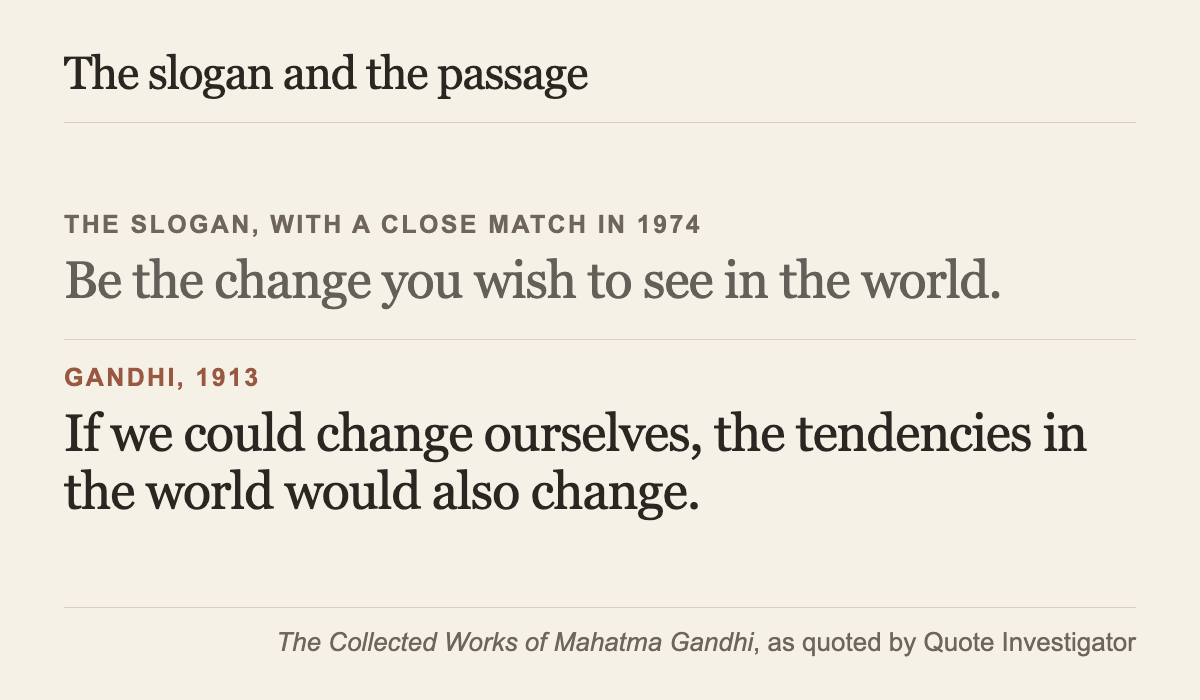
“Be the change you wish to see in the world” has not been found in anything Gandhi wrote or said. The nearest thing in his collected works is a 1913 passage that makes a related point at greater length. The slogan in its modern form first appears in 1974, in the words of an American teacher named Arleen Lorrance. [1]
What Gandhi wrote
If we could change ourselves, the tendencies in the world would also change. As a man changes his own nature, so does the attitude of the world change towards him.
Mohandas Gandhi, in an article published in 1913, as translated from Gujarati in The Collected Works of Mahatma Gandhi. We quote it as reproduced by Quote Investigator, which traced the saying. [1]
Where it sits
The setting is unexpected. The passage comes from a piece about snakebite, in a series Gandhi wrote on health. The sentences around it say that we “but mirror the world,” that the tendencies of the outer world are found in our own bodies, and, a little further on, “We need not wait to see what others do.” [1]
So the thought is his. What is missing is the form. Gandhi describes how the world responds when a person changes. He does not issue the short command that now carries his name.
Where the slogan came from
The earliest close match Quote Investigator has found is from 1974, a quarter of a century after Gandhi’s death. Arleen Lorrance, writing about her years teaching at a high school in Brooklyn, described giving up on trying to change everyone else: “One way to start a preventative program is to be the change you want to see happen.” It became one of the principles of a programme she called The Love Project, and it was repeated in newspapers and advice columns through the 1970s. [1]

The credit to Gandhi shows up later. Quote Investigator cites a 1987 newspaper report that gives him the saying, and calls that attribution implausible. Its conclusion is that Gandhi wrote a pertinent passage and that Lorrance should receive credit for the expression. [1]
How it is usually used
The line is on classroom walls, charity posters and conference slides, nearly always with Gandhi’s name under it. The idea survives the misattribution. But the name does work the words alone do not: it lends the authority of a man who led a mass movement to a sentence that asks only for personal change. Gandhi’s own passage is quieter, and it sits inside a life that was anything but private.
Should you still quote it?
Our view: yes, without the name, or with the right one. If you want Gandhi, quote what he wrote: “We need not wait to see what others do” is short, his, and makes the same point.
Further reading: Haythum’s piece on Famous Quotations digs into where the quote came from. We think it is very good, and we think you will enjoy it too.