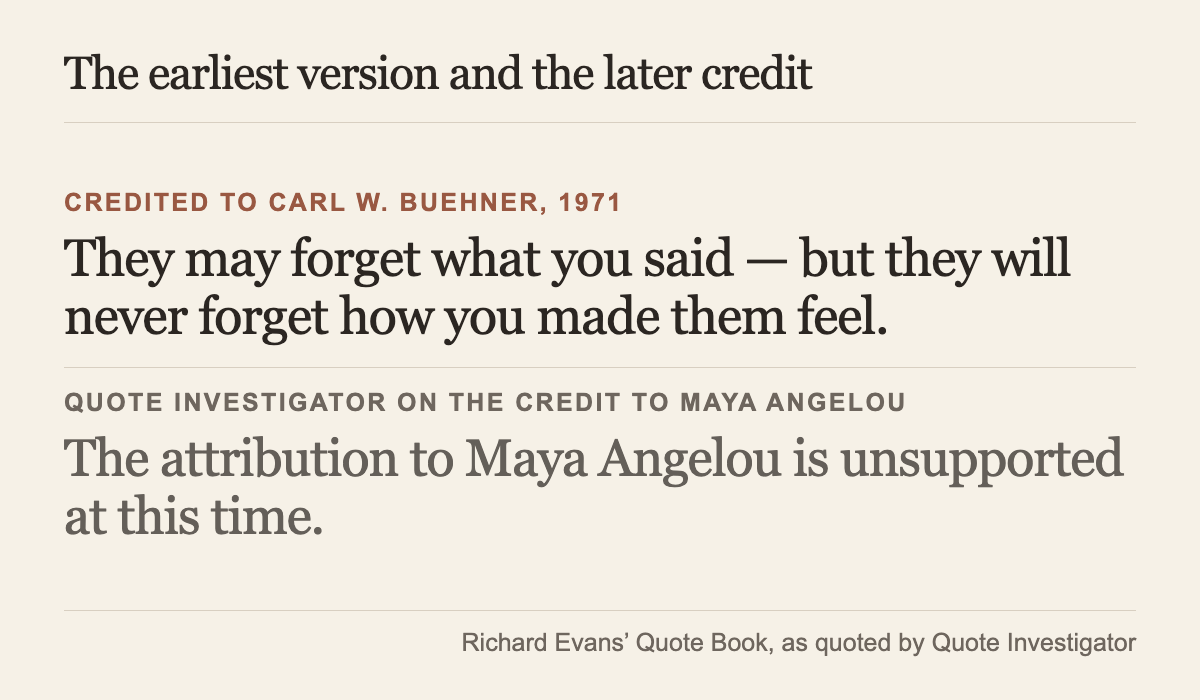
The saying that people will forget what you said but never how you made them feel is widely credited to Maya Angelou. Quote Investigator calls that credit “unsupported.” The earliest version it has found is from 1971, in a book of quotations that gives the line to Carl W. Buehner, an official of The Church of Jesus Christ of Latter-day Saints. [1]
The line, exactly
They may forget what you said — but they will never forget how you made them feel.
Credited to Carl W. Buehner in Richard Evans’ Quote Book (1971). We quote it as reproduced by Quote Investigator. [1]
Who Buehner was
Carl W. Buehner was born in Stuttgart, Germany, in 1898 and moved to Salt Lake City as a child. He served as Second Counselor in his church’s Presiding Bishopric from 1952 to 1961, ran for governor of Utah in 1968, and died in 1974. [2] The book’s compiler, Richard L. Evans, was also a prominent church figure, for more than forty years the narrator of the Mormon Tabernacle Choir’s broadcast “Music and the Spoken Word.” [1]

How the saying traveled
Many of the early sightings come from people who teach speaking and selling. A 1989 marketing handbook used it as a chapter epigraph, with Buehner’s name. A 1993 trade column gave it to Don Aslett, the author of a book on speechmaking: “People may forget what you said, but they’ll never forget how you made them feel.” In January 1996 The Rotarian again credited “speechmaker Carl W. Buehner.” [1]
Along the way it was reworded. A 1995 report from Owensboro, Kentucky, quotes a speaker named Hankins: “People will forget what you did,” he said. “People will never forget how you made them feel.” [1]
How Angelou’s name got attached
Quote Investigator traces this to a message in circulation by 2003. It took remarks from H. Jackson Brown Jr.’s 1991 book Live and Learn and Pass It On, “implausibly” reassigned them to Angelou, and added this saying to the group. A Georgia columnist printed material from the message in March 2003. In July a Wisconsin paper reported that Angelou had issued “a list of things she has learned in 75 years of living,” with the saying among them. [1]
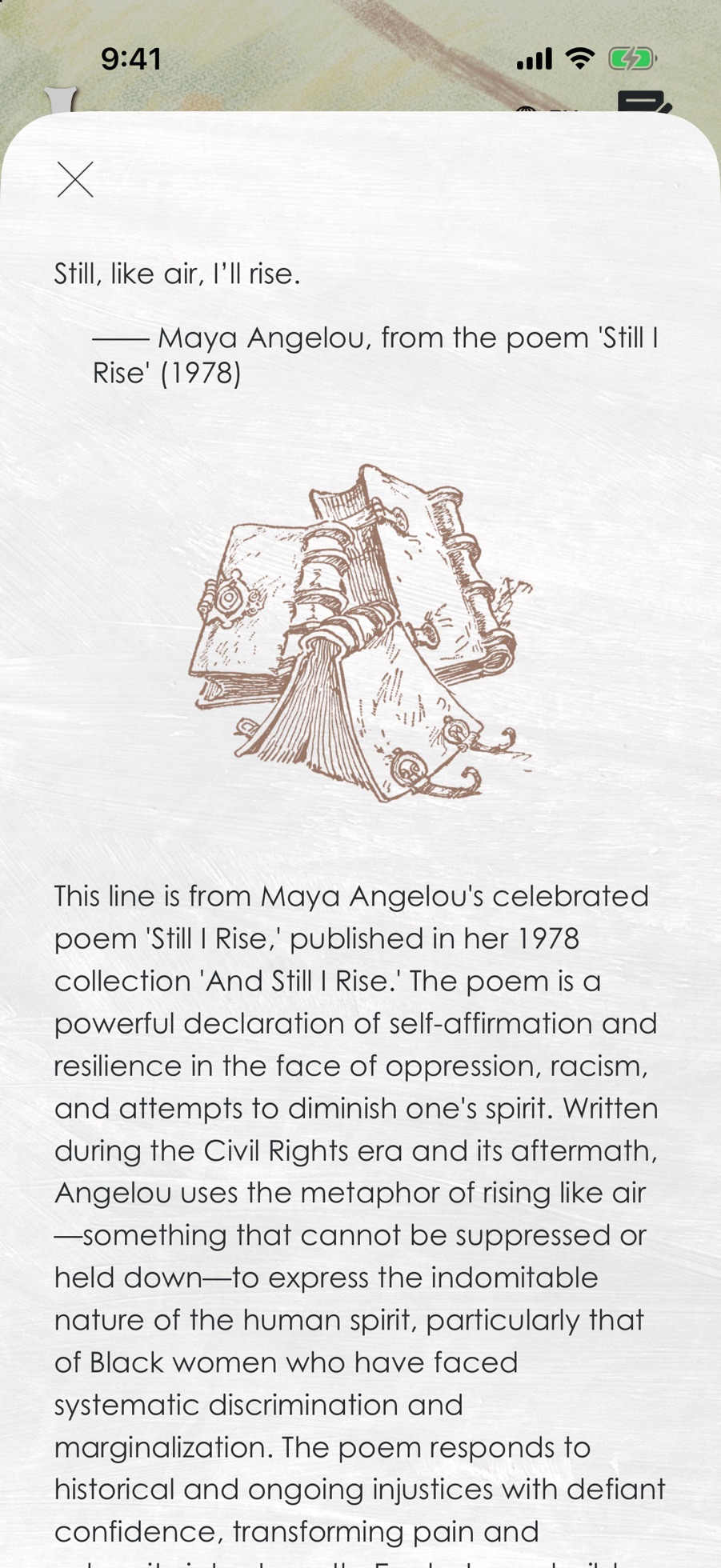
Her own writing has no need of it. In “Still I Rise” she wrote, “But still, like air, I’ll rise.” [3]
How it is usually used
The saying is offered to teachers, managers and public speakers as a reminder that manner outlasts content. Its appeal is easy to understand, and a good deal of the advice built on it is sensible. The name does some extra work: coming from a celebrated poet, it sounds like hard-won wisdom. Coming from a church official’s line in a quotation book, it is still good advice.
Should you still quote it?
Our view: yes, and credit it as “often attributed to Carl W. Buehner,” or simply as a saying. Keep Maya Angelou’s name for the words she wrote.