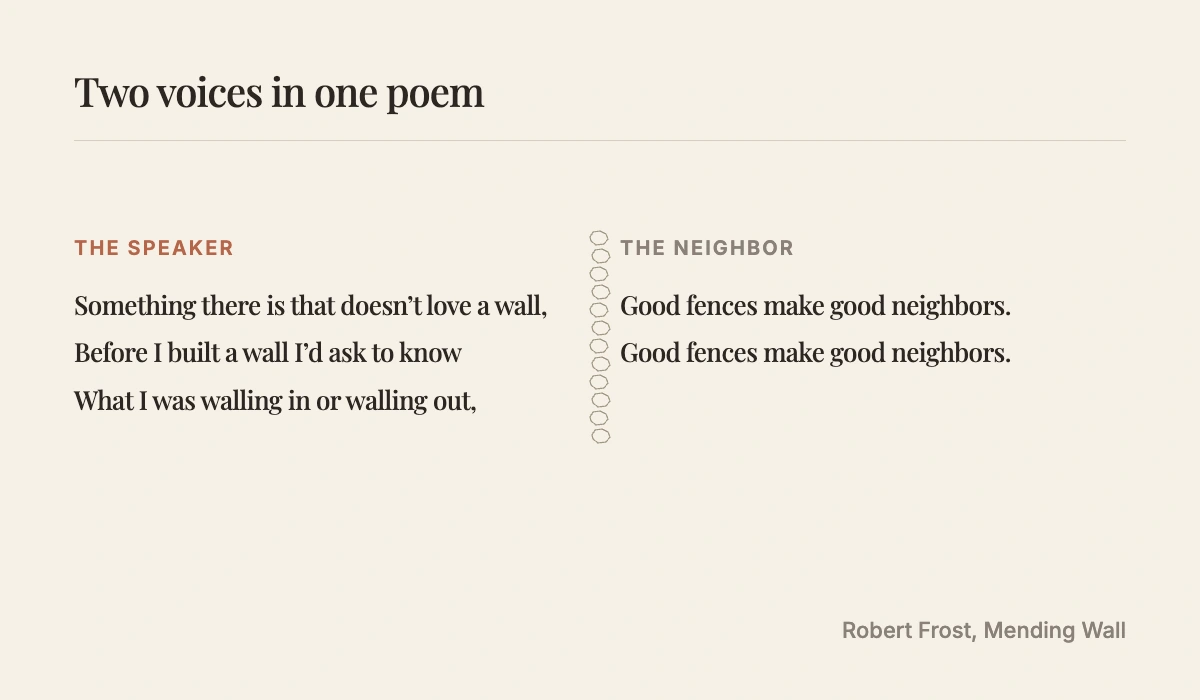
“Good fences make good neighbors” is often quoted as Robert Frost’s view. In his poem “Mending Wall” the line belongs to the speaker’s neighbor, who says it twice, while the speaker wonders aloud why the wall is needed at all. It was a proverb before Frost used it, and the poem is an argument with it. [1]
The line, exactly
He only says, ‘Good fences make good neighbors.’
Robert Frost, “Mending Wall,” from North of Boston (1914). “He” is the neighbor. The line returns as the poem’s last words: “He says again, ‘Good fences make good neighbors.’” [1]
What happens in the poem
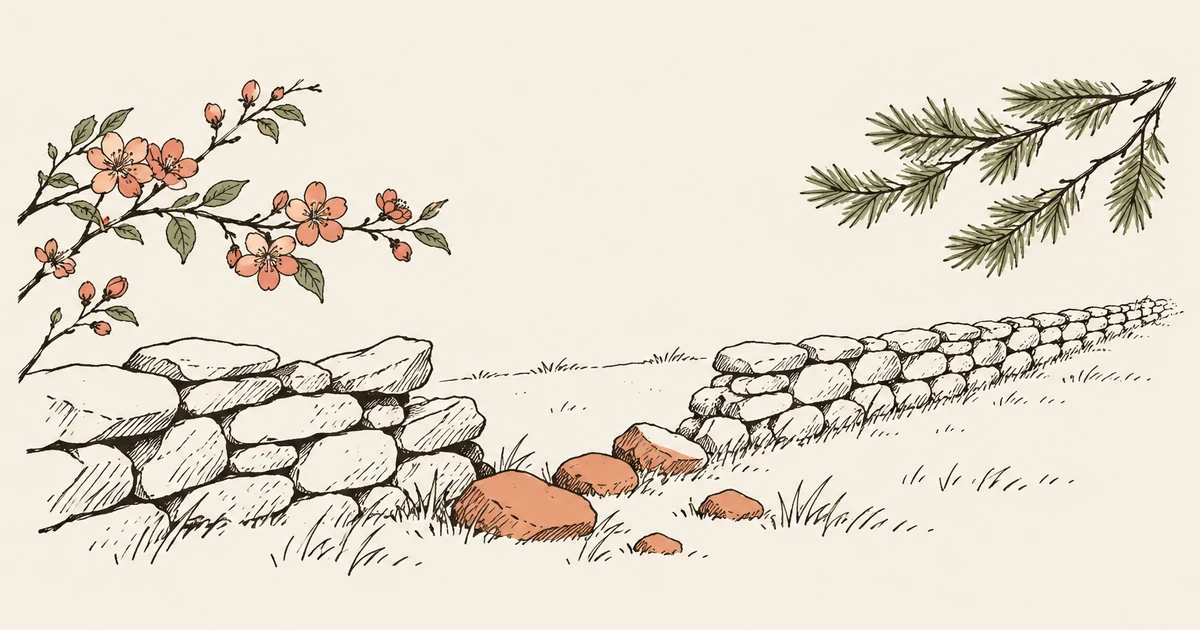
Each spring two neighbors walk the stone wall between their land and put back the stones winter has tumbled. The poem opens with the speaker’s own thought: “Something there is that doesn’t love a wall.” Frost and hunters undo it every year. [1]
The speaker teases his neighbor. One of them has pine and the other apple orchard, and “My apple trees will never get across / And eat the cones under his pines.” There are no cows to keep in. “Before I built a wall I’d ask to know / What I was walling in or walling out.” [1]
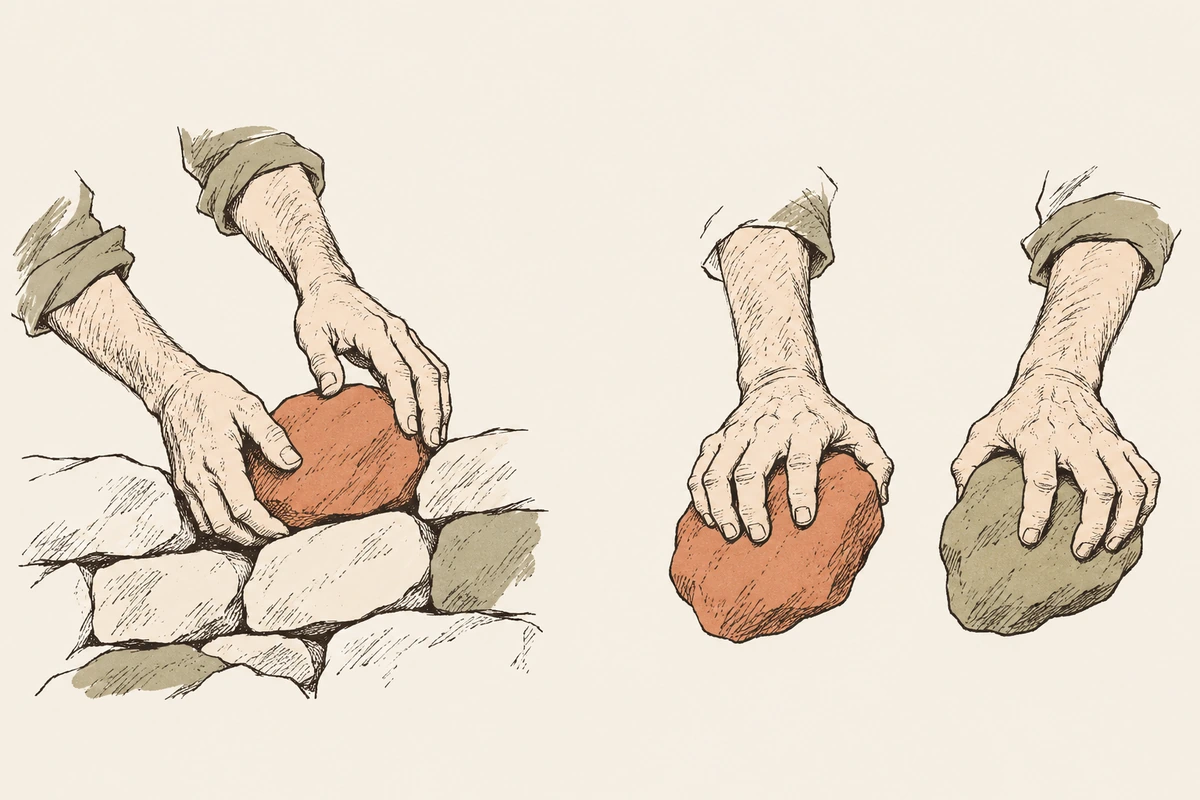
The neighbor does not argue. He repeats what his father said. The speaker sees him carrying a stone in each hand “like an old-stone savage armed,” moving in a kind of darkness, and concludes: “He will not go behind his father’s saying.” [1]
Is the speaker simply right?
Not quite, and this is what keeps the poem interesting. It is the speaker who tells his neighbor each year that it is time to mend the wall, and he joins in the work. The wall is also the one thing that brings the two men together. Frost gives the doubter the best lines and the neighbor the last word. [1]
Older than Frost
Frost did not invent the saying. It was already proverbial, and one study of the poem reports that it is first found in a newspaper, the Western Christian Advocate, in June 1834, citing The Yale Book of Quotations. In the poem it is exactly that: an inherited phrase, said without being examined. [2]
How it is usually used
In arguments about property lines, office etiquette and national borders, the line is offered as plain wisdom with a poet’s name attached. That turns the poem inside out. Quoting it as Frost’s advice is a little like quoting the neighbor and leaving out the speaker.
Should you still quote it?
Our view: yes, as a question. The poem does not tell you walls are bad. It tells you to ask what you are walling in or walling out before you build, and to notice when you are only repeating what you were told.