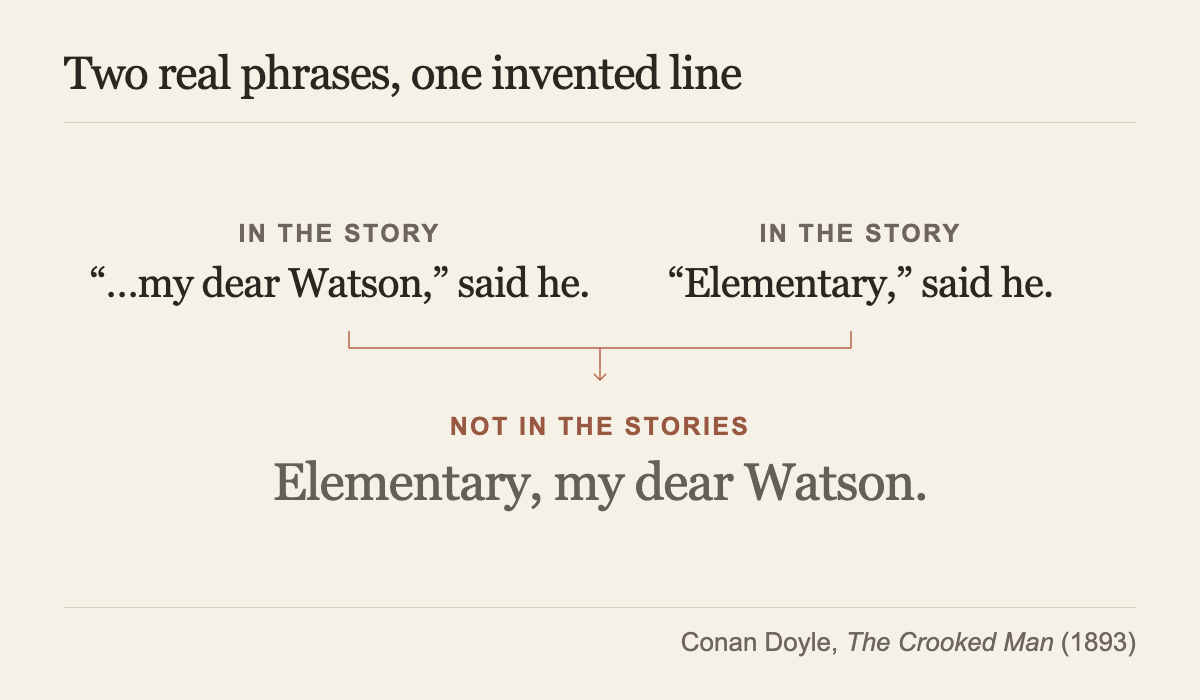
“Elementary, my dear Watson” is not in Conan Doyle. Across the 56 short stories and four novels, Holmes never says it. He does say “Elementary,” and he does say “my dear Watson,” and in one story the two come within a few lines of each other. The famous sentence was put together afterwards. [1] [2]
The line, exactly
“Excellent!” I cried.
“Elementary,” said he.
Arthur Conan Doyle, “The Crooked Man,” first published in 1893 and collected in The Memoirs of Sherlock Holmes. Watson is the “I.” [1]
Where it sits in the story
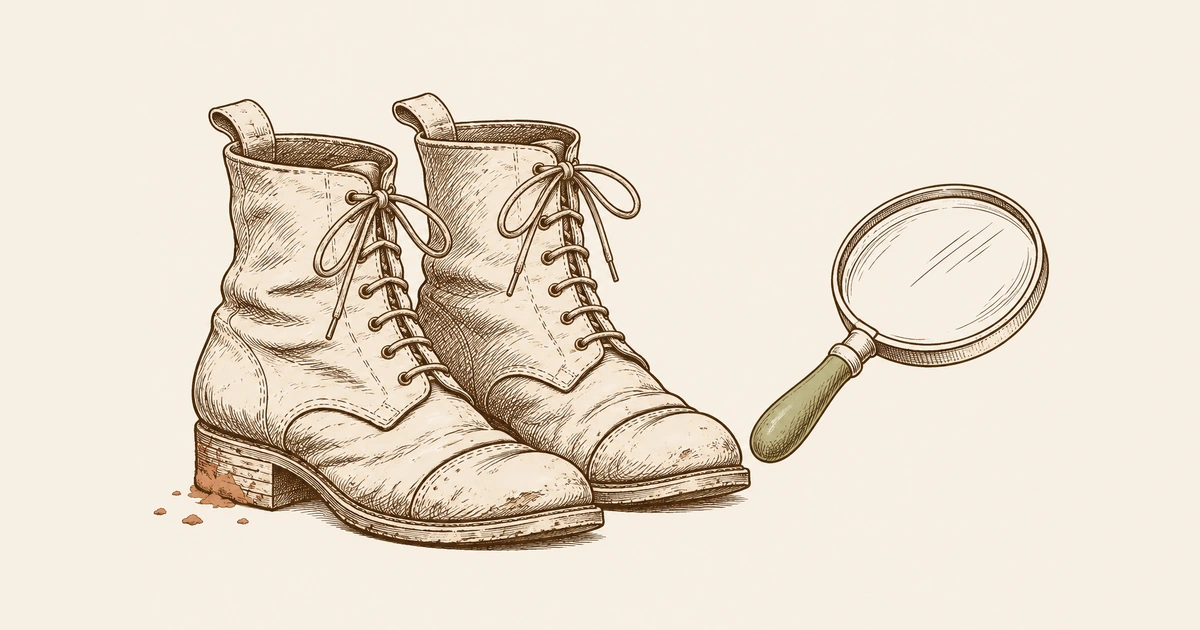
Holmes has just told Watson, from the state of his boots, that he is busy enough with patients to be taking cabs. Watson asks how he knew. “I have the advantage of knowing your habits, my dear Watson,” Holmes says, and explains. Watson is impressed; Holmes brushes it off with one word. So both halves of the famous line are on the same page, in the same exchange, but they are never one sentence. [1]
What Holmes says next is the real point of the scene. The trick, he explains, is “one of those instances where the reasoner can produce an effect which seems remarkable to his neighbour, because the latter has missed the one little point which is the basis of the deduction.” He is telling Watson it is not magic. [1]
How the line was assembled
Quote Investigator has traced the steps. In 1902 an article about Doyle’s teacher Joseph Bell imagined Holmes saying “It is the merest elementary knowledge, my dear Watson.” By 1908 a London newspaper printed the exact phrase, “Elementary, my dear Watson,” as a joke about a sharp-eyed lawyer, and by 1909 an American paper could write “as Sherlock Holmes was wont to say.” Nobody knows who first put it that way. [2]
P. G. Wodehouse helped it along. In his 1915 novel Psmith, Journalist, the hero works something out and murmurs, “Elementary, my dear Watson, elementary.” And in the first Holmes film with sound, in 1929, the detective was finally given the line himself, in a script Conan Doyle did not write. [3] [2]
How it is usually used
People say it when an answer is obvious, usually with a little mock superiority. That is fair to the character. Holmes does talk down to Watson, and “elementary” is his word. What the invented line adds is polish: it is a catchphrase, and the Holmes of the stories does not have one.
Should you still quote it?
Our view: yes, as a line about Holmes more than a line by him. It is a good example of how a quotation can be true to a character and still be something he never said. If you want the real thing, “Elementary,” on its own, is drier and funnier.