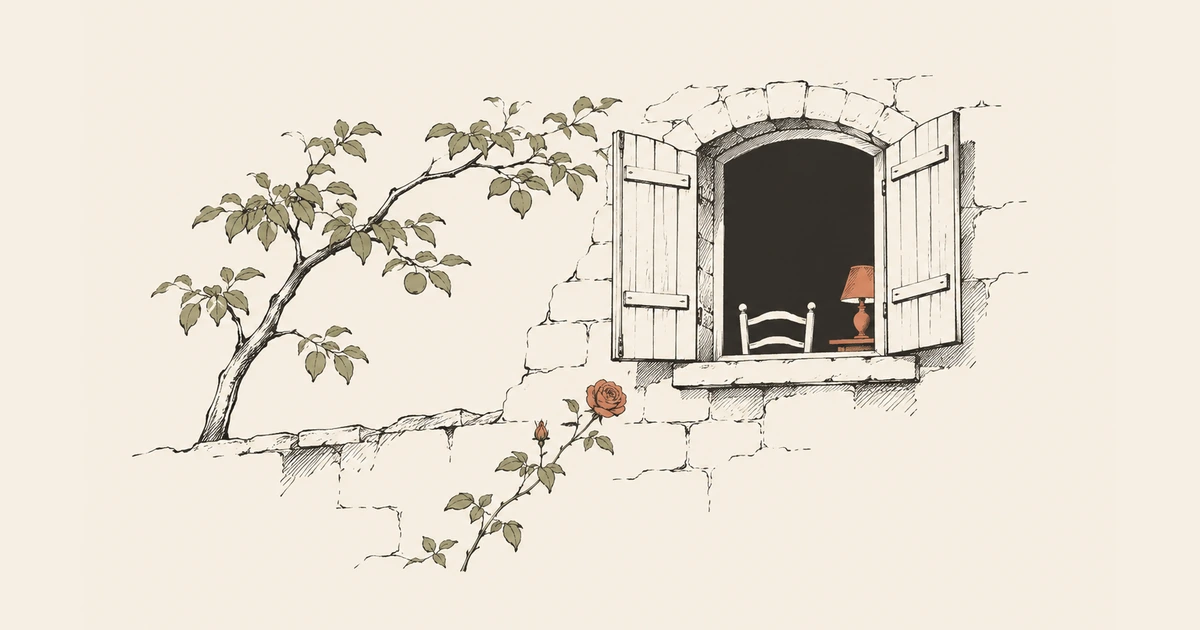
“Wherefore art thou Romeo?” does not mean “Where are you, Romeo?” “Wherefore” means “why.” Juliet, alone at her window, is asking why he has to be Romeo, a Montague, the one name her family forbids. She does not know he is standing in the garden below. [1]
The line, exactly
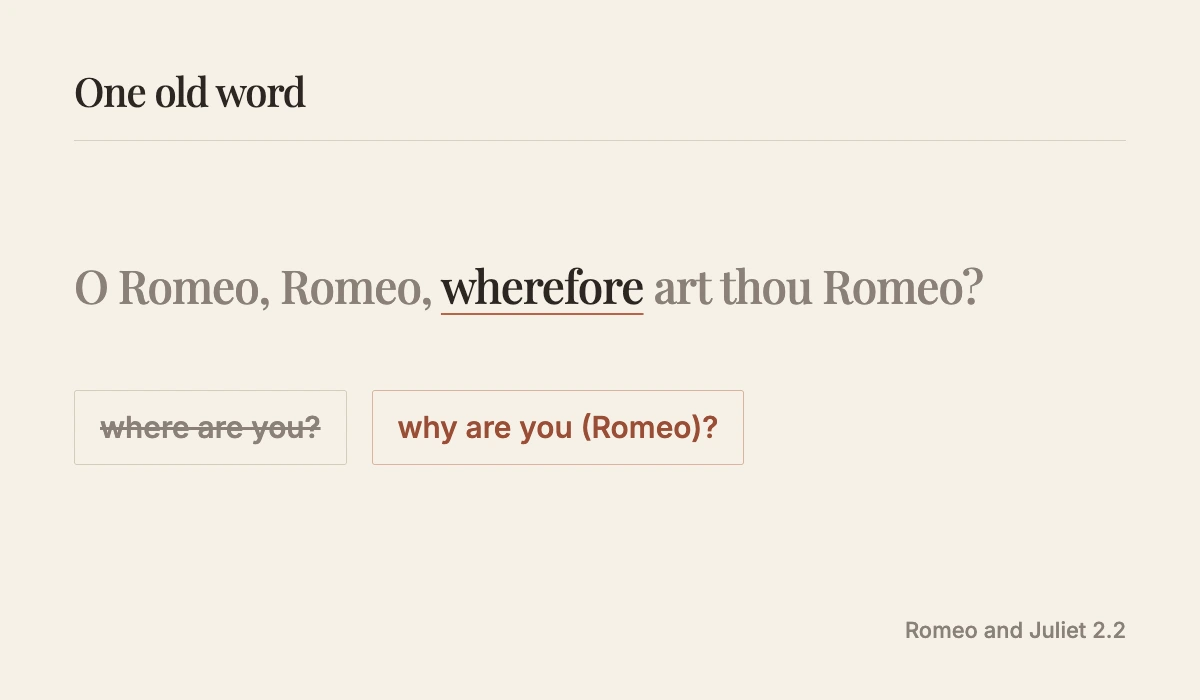
O Romeo, Romeo, wherefore art thou Romeo?
Deny thy father and refuse thy name,
Or, if thou wilt not, be but sworn my love,
And I’ll no longer be a Capulet.
William Shakespeare, Romeo and Juliet, Act 2, scene 2. Juliet is speaking to herself. [1]
There is no comma before the last “Romeo.” She is not calling to him. “Romeo” is what she is asking about: why are you Romeo?
Where it sits in the play
Hours earlier, Romeo and Juliet met at her family’s feast and fell for each other before learning each other’s names. He is a Montague and she is a Capulet, and the two houses are at war. After the feast Romeo climbs into the Capulet orchard. Juliet comes to her window believing she is alone and thinks aloud. [1]
What follows is an argument about names. “’Tis but thy name that is my enemy.” A name, she reasons, is no part of a person: “What’s in a name? That which we call a rose / By any other word would smell as sweet.” If he would give up his name, she would give up hers. Only then does Romeo speak and reveal he has heard everything. [1]

What “wherefore” means
“Wherefore” is an old word for “why” or “for what reason.” It survives in the phrase “the whys and wherefores.” Shakespeare uses it this way throughout his plays. Read with “why,” the first four lines make one clear thought: why are you who you are; change your name, or let me change mine.
How it is usually used
The line is quoted, and acted in parodies, as a search: someone leans out and scans the distance, calling for a person who has not turned up. It is a natural mistake, since “wherefore” contains “where.” But it removes the point of the speech. Juliet’s problem is not that Romeo is missing. It is that he is a Montague.
Should you still quote it?
Our view: yes, for what it means. It is one of the plainest statements in English of a real difficulty: loving someone whose name, family or side is the wrong one. Used that way, it still does its work.