“I think, therefore I am” is often read as a boast about the mind: thinking is what makes us who we are. Descartes meant something narrower. It is the one statement he found he could not doubt, after deciding to doubt everything he possibly could. [1]
The line, exactly
…I observed that this truth, I think, therefore I am (COGITO ERGO SUM), was so certain and of such evidence that no ground of doubt, however extravagant, could be alleged by the sceptics capable of shaking it…
René Descartes, Discourse on the Method (1637), Part IV, in John Veitch’s translation. Descartes wrote the book in French, where the phrase is je pense, donc je suis; the Latin in brackets is the form in which it became famous. [1]
How he gets there
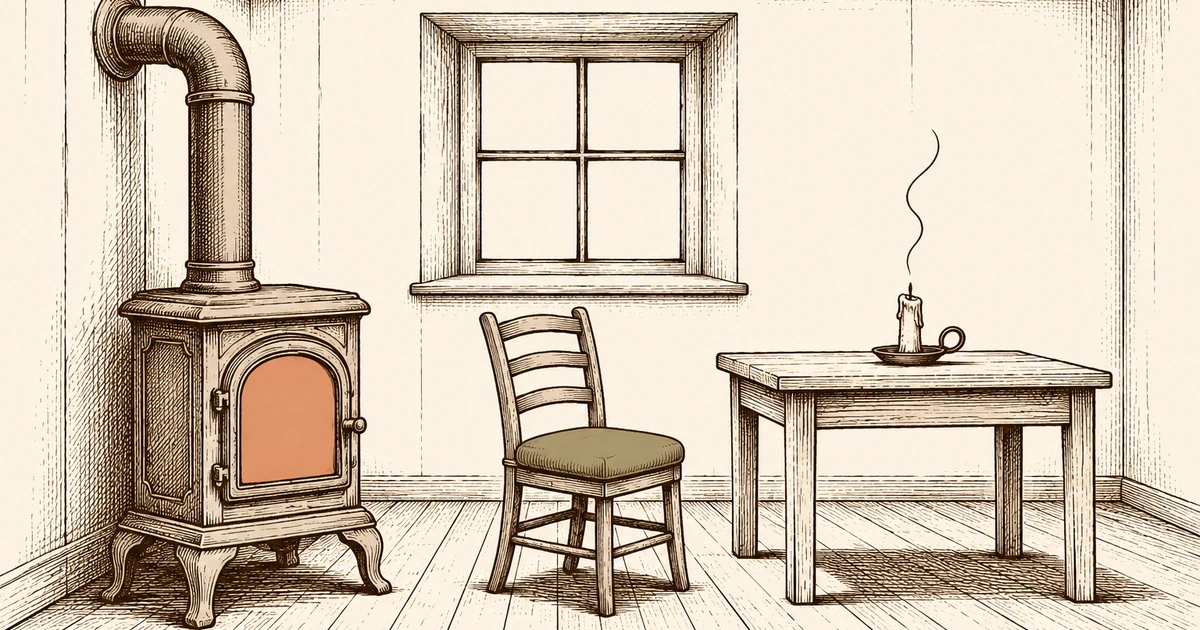
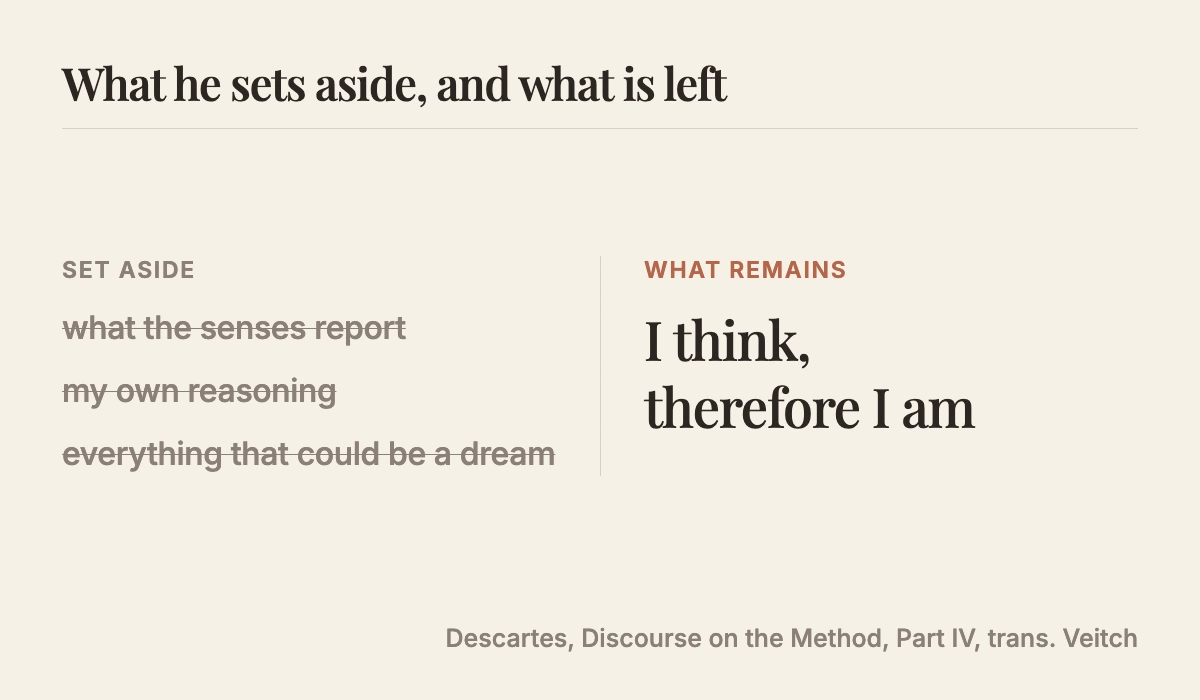
Descartes sets himself a test. He will “reject as absolutely false all opinions in regard to which I could suppose the least ground for doubt,” to see whether anything is left. The senses sometimes deceive, so he sets aside what they report. People make mistakes even in simple geometry, so he sets aside his own reasoning. And because the thoughts we have awake can also come in dreams, he supposes that everything in his mind has “no more truth than the illusions of my dreams.” [1]
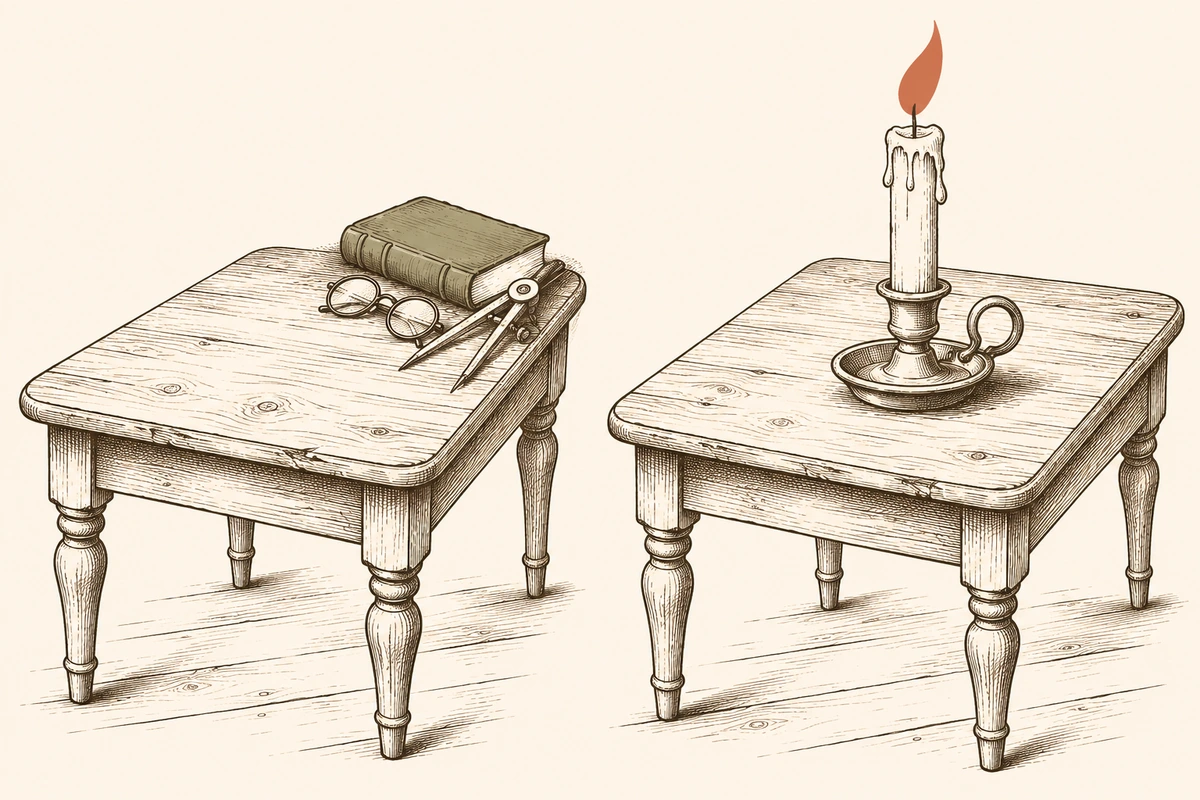
Then he notices the one thing the test cannot remove. While he was trying to think that everything was false, “it was absolutely necessary that I, who thus thought, should be somewhat.” Something is doing the doubting. That is the whole content of the famous line, and he accepts it as “the first principle of the philosophy of which I was in search.” [1]
What it means there
It is a floor, a place to stand. The sentence does not say that thinking is the best part of a person, that clever people exist more than others, or that the body does not matter. It says: even if I am wrong about everything else, I cannot be wrong that I am here being wrong.
It is also in the first person for a reason. Each reader is meant to run the test for themselves. Nobody can do the doubting for you.
How it is usually used
The line now works as a template: “I shop, therefore I am,” “I post, therefore I am.” In that form it means “this activity defines me.” Serious uses often make the same move, treating it as a claim that reason is the essence of being human. Whatever one thinks of that claim, the sentence in the Discourse is doing a different job: proving that anything exists at all.
Should you still quote it?
Our view: yes, and it is more interesting as he meant it. Read as a slogan for intelligence, it flatters. Read in place, it is a careful person finding the least he can be sure of and agreeing to start from there.