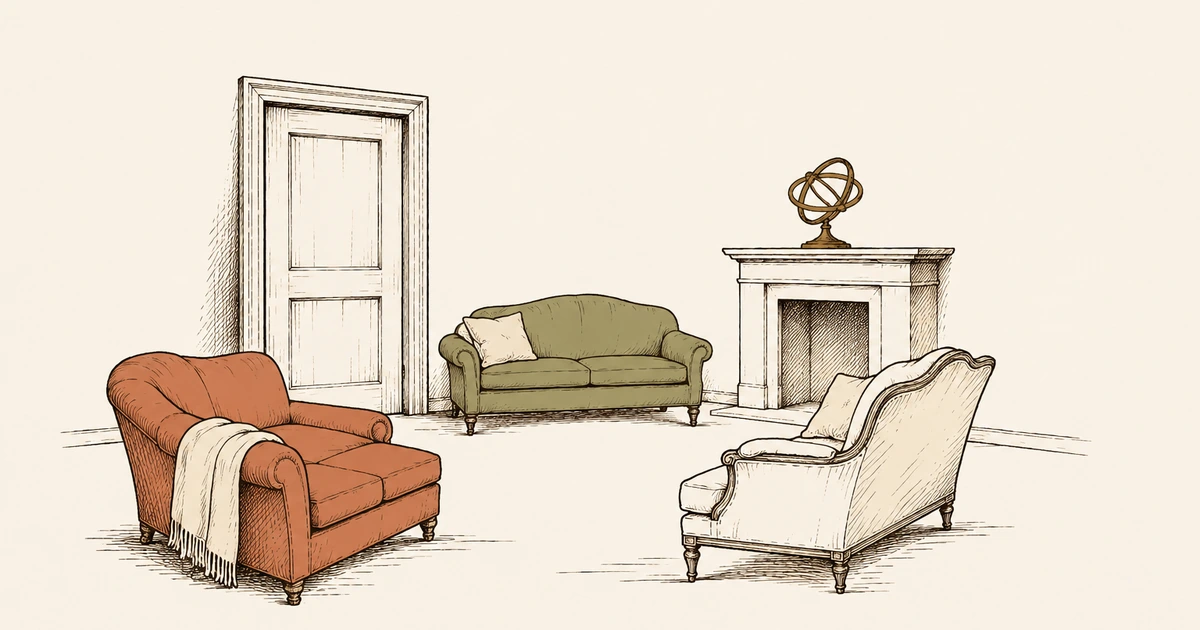
“Hell is other people” is usually quoted to mean that other people are tiresome and we are better off alone. Sartre said the line had “always been misunderstood.” He meant that when our relations with others go wrong, their judgment of us becomes a trap, because we rely on other people to know who we are. [1]
The line, exactly
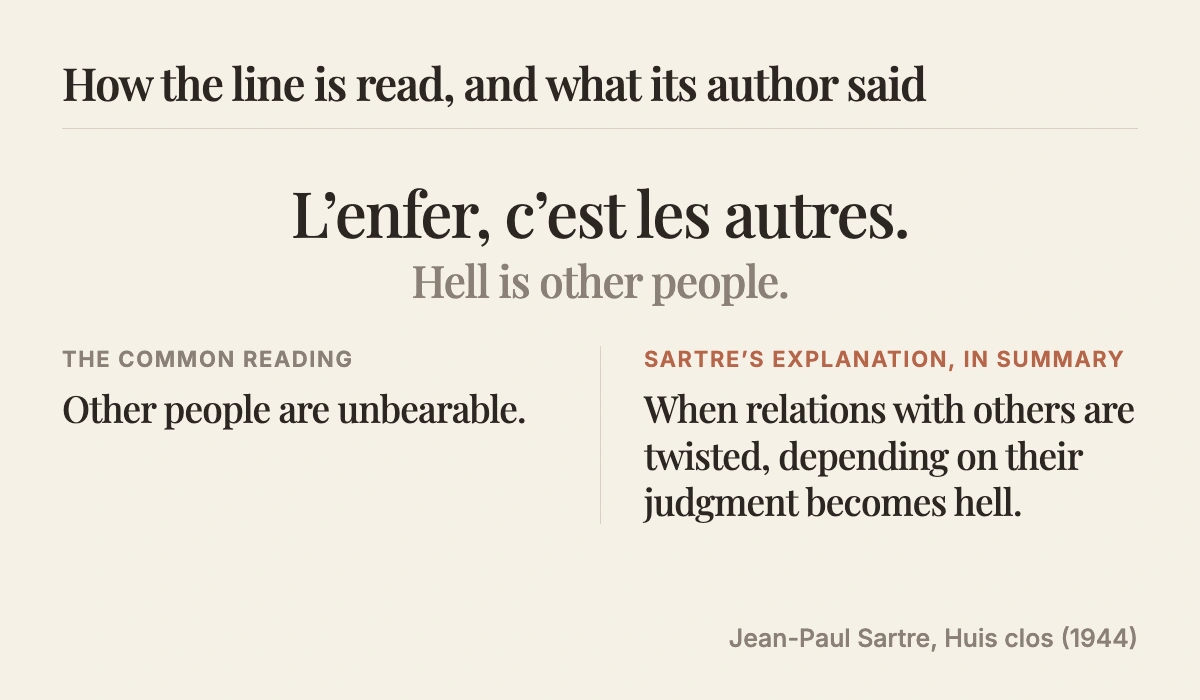
L’enfer, c’est les autres.
Jean-Paul Sartre, Huis clos (1944), known in English as No Exit. The usual English rendering is “Hell is other people.” The play is still in copyright, so we quote only this line.
Where it sits in the play
Three people who have died, Garcin, Inès and Estelle, are shown one by one into a drawing room. They expect fire and instruments of torture, and find sofas. There is no torturer. Slowly they work out the arrangement: they have been put together because each of them is exactly the person who can torment the other two, by seeing them as they are and refusing them the answer they want. Garcin says the line near the end, when he understands this.
What Sartre said about it
In a spoken introduction recorded in the 1960s, Sartre took up the line directly. People had assumed, he said, that he meant our relations with others are always poisoned. He meant something else: if our relations with another person are twisted, then that person can only be hell. [1]
His reason is the interesting part. Other people, he says, are the most important thing we have for knowing ourselves. When we try to judge ourselves, we use what others already know about us and the terms they have given us. So a person who depends completely on the judgment of others, and has bad relations with them, is in hell. He adds that this does not mean we cannot have other kinds of relations with people. [1]
What it means there
The three characters cannot leave, cannot sleep and cannot look away from one another. Each needs one of the others to confirm a flattering story about their life, and none will. The play shows what it is like to exist only in someone else’s eyes when those eyes are hostile. That is the hell of the title.
Sartre also said the characters are dead for a reason: they stand for people who are stuck in habits and in others’ verdicts on them and no longer try to change. The living, he says, can always act to break out. [1]
How it is usually used
The line is a favourite of anyone leaving a crowded train or a long meeting. As a joke it is harmless. As a summary of Sartre it is the reverse of what he said. His claim is that we cannot do without other people, which is exactly why bad relations with them are so punishing.
Should you still quote it?
Our view: as a joke, of course. If you mean it seriously, it is worth knowing that the author thought the cure was better relations with people and a readiness to change. He did not recommend fewer people.