

The answer depends on what you mean by “affirmations”
Some self-affirmation exercises have produced small average benefits in research. That does not establish that repeating any upbeat sentence will help everyone—or that reading quotations has the same effects. The useful question is: What did people actually do, and what changed afterward? [1] [2]
Start by separating three activities that often share a label. The distinctions below describe how you engage with words; they are not a ranking of which words you should prefer.
Three activities, three different questions

- Values affirmation: reflecting on a personally important value, relationship, or attribute. A study might ask people to write about why a value matters. The focus is a meaningful part of their life. [1]
- Positive self-statement: asserting something favorable about yourself. Repeating a sentence is a different task from explaining a value. [3]
- Quotation reading: engaging with someone else’s words. You might consider, question, or save a line without asserting that it describes you. This is an editorial distinction, not an experimentally established treatment category.
The forms can overlap. You could use a quotation to begin writing about a value, or repeat a quoted first-person sentence. To apply a research finding, you still need to match the actual activity, context, comparison, and outcome.
Quotation reading is the form Luminora is built around, so we have an interest here and want to say so. What it adds is the story: on literary quotes in LEARN, Context shows where the line comes from, what was happening when it was said, and who the author was. You are reading a real person’s words in their setting instead of repeating a sentence about yourself. The research below did not test this, and we do not claim that it did.
What the research on self-affirmation supports
Health messages: a small average difference, with limits
Epton and colleagues’ 2015 meta-analysis compared affirmation with nonaffirming control tasks in health-information contexts. Most studies used values exercises and student samples. Its three outcome summaries were: [1]
- Message acceptance: 34 tests, 3,433 participants; d = 0.165, 95% CI 0.026–0.305.
- Intentions: 64 tests, 5,564 participants; d = 0.142, 95% CI 0.050–0.234.
- Behavior: 46 tests, 2,715 participants; d = 0.315, 95% CI 0.189–0.442.
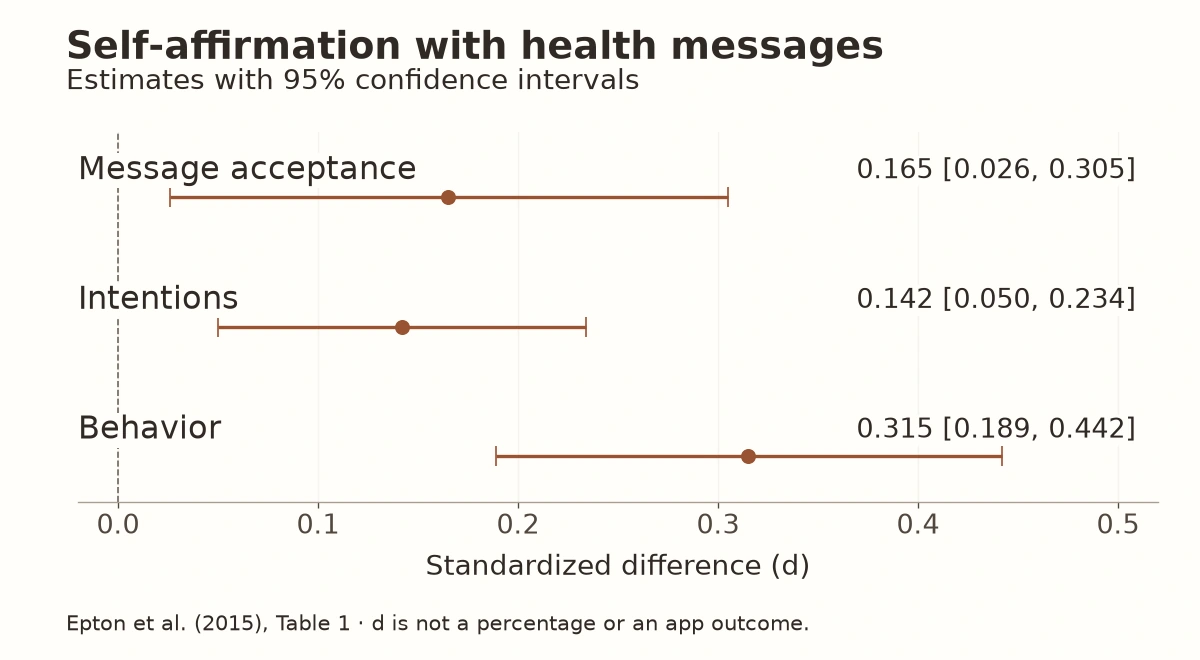
These are the Table 1 values, expressed as standardized mean differences. d = 0.315 does not mean a 31.5% improvement. Samples overlap across outcomes, so the participant counts cannot be added into a total of unique people. A confidence interval describes uncertainty around an estimated average; it does not tell you the chance that you personally will benefit.
Results varied substantially across studies. In a sensitivity analysis restricted to larger groups, the message-acceptance interval crossed zero. The review included unpublished findings, but publication bias could not be ruled out. Behavioral outcomes included both observed and self-reported measures. The conclusion is about adding an exercise to health information—not about quotations, a universal daily routine, or an app. [1]
Well-being: encouraging averages do not guarantee individual results
Zhang and colleagues’ 2025 review pooled 129 tests from 67 articles in nonclinical populations, mostly students. It examined standalone exercises against nonaffirmation controls; most exercises involved values. Table 1 reports these Hedges’ g estimates and 95% confidence intervals: [2]
- Self-perception: 0.32 [0.22, 0.43].
- General well-being: 0.29 [0.17, 0.41].
- Social well-being: 0.26 [0.17, 0.35].
- Psychological barriers: −0.22 [−0.30, −0.13]; lower scores favored affirmation.
These are small average standardized differences, not percentages. All four prediction intervals crossed zero: the average should not be treated as the result expected in every setting. The review was not preregistered, restricted inclusion to English-language peer-reviewed work, and excluded clinical and certain minority-group samples. It also excluded comparisons against other active psychological interventions. Most tests measured outcomes immediately; follow-up evidence was limited and varied. It does not establish a dependable duration of benefit or superiority to therapy. [2]
Why the evidence on positive self-statements is more complicated
In Wood and colleagues’ 2009 experiment, 68 students wrote down their thoughts for four minutes; one group also repeated “I am a lovable person.” Among students selected for low self-esteem, the repetition condition produced worse immediate mood results. Not every outcome reached statistical significance. A second experiment compared positive-only with more balanced reflection. These were specific exercises in selected student samples, with no evidence here of lasting harm. [3]
Later evidence complicates that story. Flynn and Bordieri’s 2020 university studies reported failure to replicate the earlier pattern. Study 1 compared a positive statement with no statement; Study 2 compared positive statements with values writing, measuring outcomes immediately and after three days. Their detailed abstract reports no condition differences on the specified outcomes. We could inspect that abstract, not the full report. [4]
A nonsignificant result is not proof that two activities are equivalent. And comparing two active exercises does not show that both are ineffective. Taken together, these studies do not justify telling every person with low self-esteem to avoid all encouraging words, or telling everyone that repetition reliably improves mood. They also do not test the original examples below. [3] [4]
What this evidence does—and does not—let us conclude
- Supported: some defined self-affirmation exercises have modest average effects in the populations and contexts studied.
- Still uncertain: who will benefit from a particular sentence, how long any benefit will last, and what everyday repetition adds.
- Not established by these sources: that reading a quote reproduces a writing intervention, that a specific app improves mental health, or that words alone change external circumstances.
When you encounter a claim that affirmations are “scientifically proven,” look for the exercise, comparison group, population, and outcome. A study of openness to a health message answers a different question from a study of mood. Neither directly answers whether a particular quote on your phone will help you.
A modest way to explore words for yourself
The following are original editorial suggestions from the Luminora Team, not a tested protocol or a prescribed repetition schedule. Use them to choose what feels meaningful without turning your reaction into a test you can fail.
- Name something you value. For example: “Being dependable matters to me because I want people to know when they can count on me.” You can write a specific memory underneath it.
- Leave room for the present moment. For example: “I feel unsure, and I can ask one clear question.” You do not have to replace a difficult feeling with a sweeping claim.
- Connect words to a choice. Ask: “What would this value look like in the next conversation?” An answer might be listening, asking for time, or making a manageable commitment.
- Notice your response. You can revise a sentence, switch to a different passage, or stop. Feeling unmoved by a phrase is not a personal failure.
If you prefer reading to writing, a quotation can simply be something to think with. You do not have to repeat it, agree with every part of it, or expect it to change your mood. Check its source and distinguish the author’s words from your own interpretation.
Where Luminora fits
Luminora offers quote reading, SEEK, and LEARN. SEEK pairs a question with a relevant quote and reflection; LEARN lets you save favorites and explore collections. These are product functions described in the official listing, not outcomes measured by the studies above. [5]
If first-person statements feel untrue when you say them, reading an attributed quotation is a different activity: you read what someone else said and decide what you make of it. On literary quotes in LEARN, a Context button shows the source of the line, what was happening when it was said, and who the author was. That is a product function. None of the studies above tested quote reading or Luminora. See a real example of Context. [6]

You could read a line, consider what it means in your situation, and save it if you want to return to it. If you are choosing an app, our comparison of affirmation apps sets out what each one does. For a concrete introduction, see what Luminora does. Its invitation remains: Find the light within you.