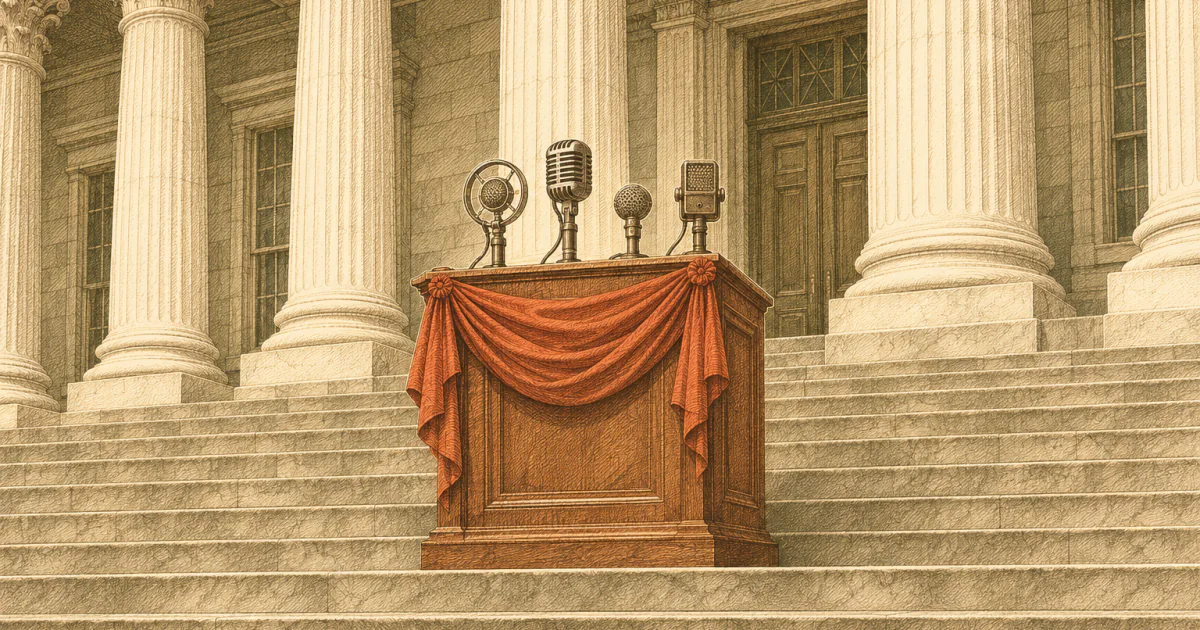
“The only thing we have to fear is fear itself” comes from Franklin D. Roosevelt’s first inaugural address, given in Washington on March 4, 1933. The sentence does not stop at “itself.” Roosevelt goes on to say which fear he means: an unreasoning panic that stops people from acting. He was speaking in a banking crisis. That day, banks in thirty-seven states were closed or limiting withdrawals. [1] [4]
The line, exactly
So, first of all, let me assert my firm belief that the only thing we have to fear is fear itself—nameless, unreasoning, unjustified terror which paralyzes needed efforts to convert retreat into advance.
Franklin D. Roosevelt, first inaugural address, March 4, 1933. The sentence reads the same in the text published by the Avalon Project at Yale Law School and in the American Presidency Project’s transcript of the speech as delivered. The National Archives holds a copy from the Roosevelt Library’s files. [1] [2] [3]
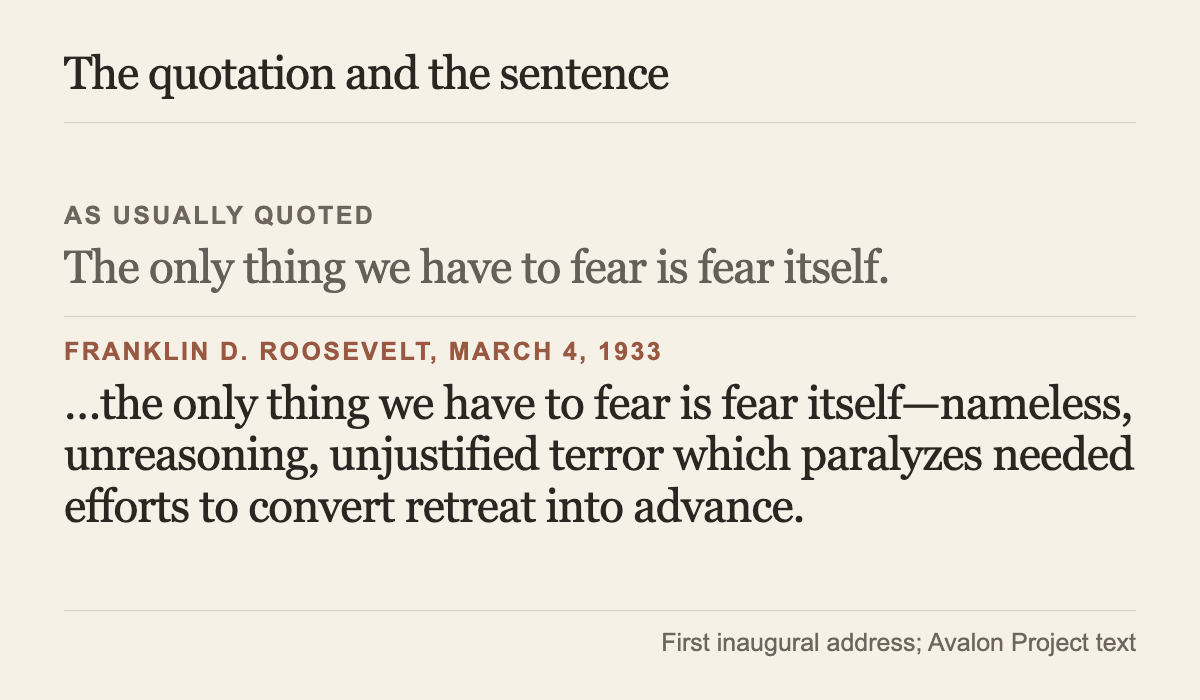
Where it sits
The line comes in the first paragraph. Roosevelt opens by promising candor: “This is preeminently the time to speak the truth, the whole truth, frankly and boldly.” Then: “This great Nation will endure as it has endured, will revive and will prosper.” The sentence about fear follows. [1]
The country listening had reason to be afraid. In the days before the inauguration, bank closures and failures had mounted. On March 4, inauguration day, in the words of the Federal Reserve’s history of the crisis, “all twelve Federal Reserve Banks kept their doors locked, and banks in thirty-seven states either closed completely or operated under state-imposed restrictions on withdrawals.” [4] The speech was broadcast nationwide on several radio networks. [6]

What it means there
The fear Roosevelt names is a particular one: “nameless, unreasoning, unjustified terror which paralyzes needed efforts to convert retreat into advance.” In a run on the banks, that kind of fear does real damage. If every depositor expects a bank to fail and takes their money out, the bank fails. The sentence asks the country to stop the panic so that recovery can be attempted.
It is not a claim that there was nothing to fear. A few lines later the speech lists the damage plainly: “the means of exchange are frozen in the currents of trade; the withered leaves of industrial enterprise lie on every side; farmers find no markets for their produce; the savings of many years in thousands of families are gone.” It blames the “unscrupulous money changers,” and near the end Roosevelt says he will ask Congress for “broad Executive power to wage a war against the emergency.” [1]
Action followed quickly. At 1:00 a.m. on March 6, Roosevelt suspended all banking transactions by proclamation, and “The crisis began to subside on March 9, when Congress passed the Emergency Banking Act.” [4]
Where the idea came from
The thought is old, and it is not settled where Roosevelt found it. Roosevelt’s close aide Raymond Moley was responsible for crafting the speech. [6] Eleanor Roosevelt later suggested the line came from Henry David Thoreau, whose journal for September 7, 1851, has “Nothing is so much to be feared as fear.” The Thoreau Society, reporting her account, adds that “the debate about the source of this historic declaration continues.” [5]
How it is usually used
The short form has become a general remedy for anxiety, in sport, business and self-help: fear is the real enemy. That is a fair extension of the sentence, but it leaves out two things. Roosevelt named a specific kind of fear, the unreasoning kind that blocks action. And he said it to clear the way for urgent action, not only to calm people down.
Should you still quote it?
Our view: yes. It is quoted accurately as far as it goes. When there is room, give the rest of the sentence; “nameless, unreasoning, unjustified terror” is the part that explains it.