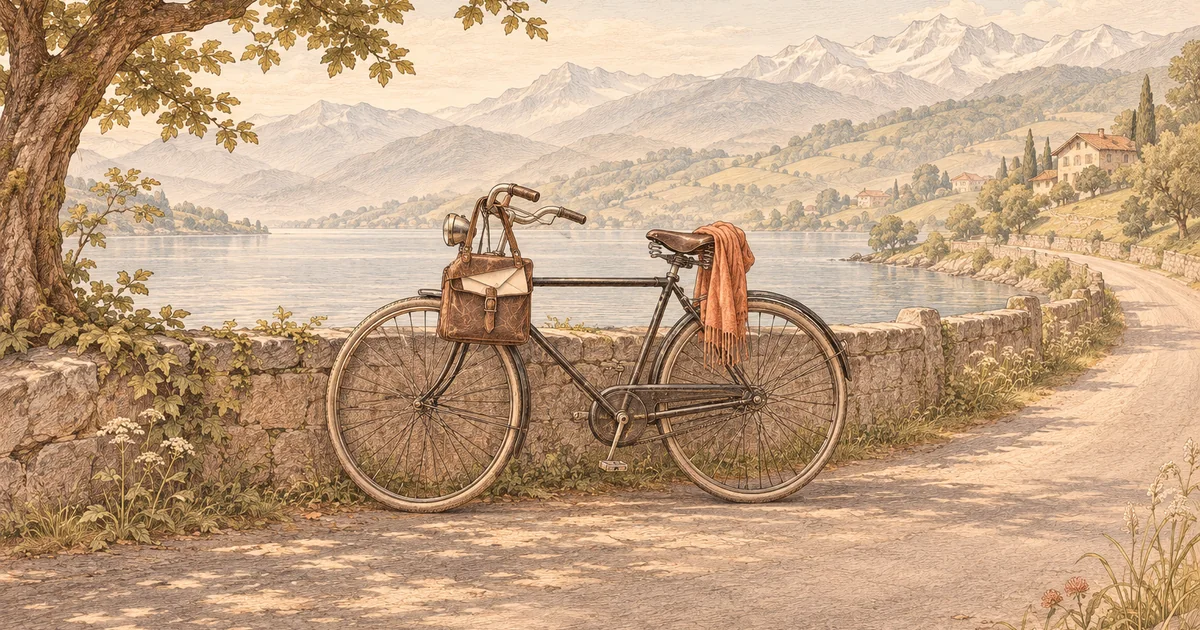
Einstein really did use the bicycle comparison. He did it in German, in a letter to his younger son, Eduard, dated February 5, 1930. The English line everyone quotes, “Life is like riding a bicycle. To keep your balance you must keep moving,” is a smoothed version of what he wrote. A closer translation is about people, not life, and about keeping one’s balance comfortably. [1]
The line, exactly
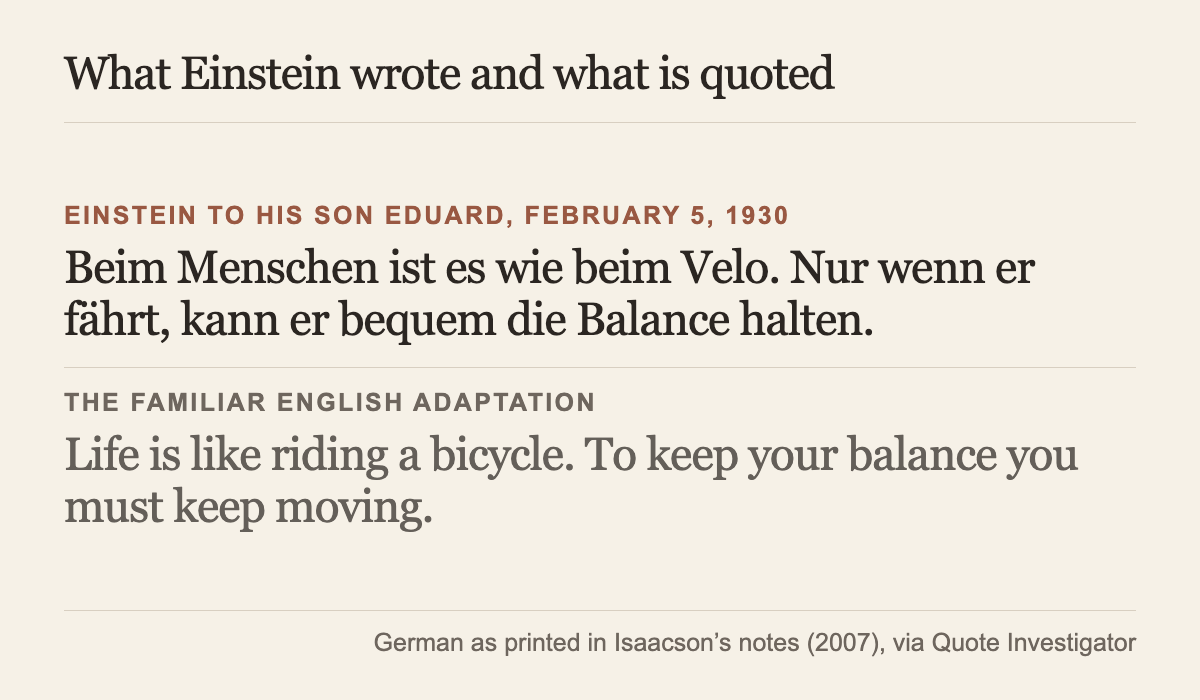
Beim Menschen ist es wie beim Velo. Nur wenn er fährt, kann er bequem die Balance halten.
Albert Einstein, letter to Eduard Einstein, February 5, 1930 (Einstein Archives 75-990). The German is printed in the notes to Walter Isaacson’s Einstein: His Life and Universe (2007) and reproduced by Quote Investigator, which types fährt without the umlaut, as “faehrt.” [1]
The same notes give a translation by Barbara Wolff of the Einstein Archives at the Hebrew University of Jerusalem: “It is the same with people as it is with riding a bike. Only when moving can one comfortably maintain one’s balance.” [1]
Where it sits
Eduard was Einstein’s younger son with his first wife, Mileva Marić. He was born in 1910. The family left Zurich for Berlin in March 1914, and that July Marić took both boys back to Zurich, in a separation that became permanent. In 1930, at around twenty, Eduard had a breakdown and was diagnosed with schizophrenia. [2]
The biographers Roger Highfield and Paul Carter describe the letter in The Private Lives of Albert Einstein (1994): “The best cure that Einstein could offer for melancholy was hard work.” In their rendering he told his son, “How beneficial a job would be for you.” The bicycle sentence belongs to that advice. [1]

What it means there
Einstein’s subject is der Mensch, a person, and his bicycle is a Velo, the everyday word in Switzerland, where Eduard lived. Only while it is moving can a person keep balance bequem, comfortably. It is a father telling a son in a hard time that being active steadies you: keep busy, keep working, and things hold together. It is advice about a state of mind, written to one young man.
How it became “Life is like riding a bicycle”
Biographers knew the letter well before the slogan. Highfield and Carter paraphrased it in 1994: “He told his son that life was like a bicycle, since a man could keep his balance only if he kept moving.” [1]
The exact familiar wording appears in Isaacson’s 2007 biography, at the front of the book as an epigraph, while the notes at the back give the closer translation. Quote Investigator calls the epigraph “a less precise translation.” Jürgen Neffe’s biography, in Shelley Frisch’s translation of the same year, has another version: “People are like bicycles. They can keep their balance only as long as they keep moving.” [1]
The image itself was older than the letter. Quote Investigator traces bicycle comparisons to 1882, when a magazine for cyclists quoted a preacher: “A great preacher,” said he, “says living a religious life is like riding the bicycle: you must go on or come down.” [1]
How it is usually used
On posters and in talks the line is about momentum: keep going and you will not fall. That is close to Einstein’s point, so the popular reading is fair. What changes is the scale and the tone. “Life” turns it into a general rule. Einstein wrote it to one person, as encouragement to stay active, and his word “comfortably” makes it gentler: standing still is a strain, not a crash.
Einstein is credited with many lines he never wrote, such as the definition of insanity. This one is his in substance, if not in its famous English form.
Should you still quote it?
Our view: yes, as Einstein’s, because the thought is his. If you want to be exact, use Barbara Wolff’s translation, or say “Einstein wrote to his son that…” and paraphrase. Either way, the letter is worth a mention. It makes the line kinder than the poster version.