

“Our Deepest Fear Is Not That We Are Inadequate”: Marianne Williamson Wrote It, Not Nelson Mandela

By Luminora TeamPublished Updated Sources checked

From the team behind Luminora. How we write and check articles.

A brass lamp lights the blank pages of a book on a desk at sunrise. An olive shawl hangs on the chair beside the window.
Original editorial illustration.

Published by the team that makes Luminora. Marianne Williamson’s book is in copyright: we quote its two opening sentences and summarize the rest of the passage from the text reproduced by Quote Investigator. We did not consult the printed book, The Tennessean or The New York Times; those are quoted as reproduced by Quote Investigator. The reading under “Should you still quote it?” is our editorial view.

The passage that begins “Our deepest fear is not that we are inadequate” was written by Marianne Williamson, in her 1992 book A Return to Love. It is often said to come from Nelson Mandela’s inaugural address of 1994. It does not: the Nelson Mandela Foundation says he used it in none of the speeches he gave at his inauguration. [1] [2]

The line, exactly

Our deepest fear is not that we are inadequate. Our deepest fear is that we are powerful beyond measure.

Marianne Williamson, A Return to Love: Reflections on the Principles of A Course in Miracles (HarperCollins, 1992), chapter 7, “Work,” page 165, as cited by Quote Investigator, which reproduces the longer passage. The book is in copyright, so we quote only these two sentences. [1]
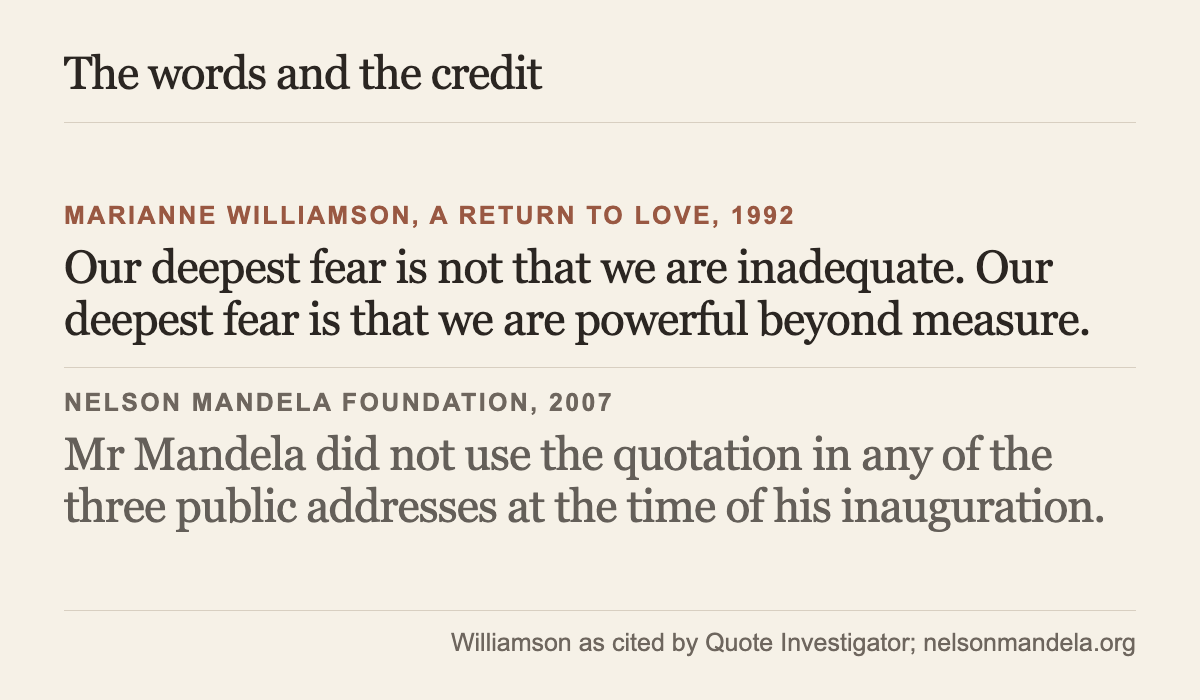
Marianne Williamson’s 1992 words “Our deepest fear is not that we are inadequate. Our deepest fear is that we are powerful beyond measure,” above the Nelson Mandela Foundation’s statement: “Mr Mandela did not use the quotation in any of the three public addresses at the time of his inauguration.”
The words are Williamson’s. The Foundation checked Mandela’s speeches.

The line is also widely shared as “Our greatest fear is not that we are inadequate.” Williamson’s word, in both sentences, is “deepest.” [1]

Where it sits

Williamson came to A Course in Miracles, a three-volume spiritual text, in 1977 and began lecturing on it in 1983. A Return to Love is her reading of it, and it became a bestseller. [1]

The passage comes in her chapter on work. It goes on to say that our light, not our darkness, is what frightens us, that playing small does not serve the world, and that each of us is a child of God. It ends with the thought that as we are freed from our own fear, our presence frees others. [1]
A cap with a terracotta tassel and an olive-tied diploma rest on a folding chair. Empty rows lead to a lectern on a tree-lined campus lawn.
Original editorial illustration.

What it means there

The passage turns a familiar idea round. Advice about confidence usually treats fear of failure as the obstacle. Williamson suggests that people also hold back because their own ability frightens them, and that hiding it is not humility. In the book the argument is religious: it rests on the claim that each reader is a child of God. Read without that frame, the passage still works as encouragement. It is just less than she wrote.

How Mandela’s name got attached

By February 1996 the passage was circulating as Mandela’s. A columnist in The Tennessean introduced it with “I like how Nelson Mandela put it in his inaugural address…” Two years later The New York Times noted that commencement speakers, Hillary Rodham Clinton among them, had quoted Mandela with these words, and added: “Problem is, Mr. Mandela never said it.” [1]

In 2007 the Nelson Mandela Foundation answered the question directly. It listed the three public addresses Mandela gave on May 9 and 10, 1994, and said he “did not use the quotation in any of the three public addresses at the time of his inauguration.” Its archivist, Razia Saleh, added: “As far as I know, he has never used the quote in any of his speeches.” [2] Williamson has said the same, calling the Mandela version “An urban myth.” [1]

How the switch began is not known. Quote Investigator does not say, and we have not found anyone who has shown it.

How it is usually used

The passage turns up at graduations, in leadership training and on posters, usually as encouragement to stop hiding one’s abilities. Mandela’s name gives it the weight of a man who came out of prison to lead his country. Taken out of its chapter, the passage also loses its religious ground, which is where Williamson rests her case against playing small.

Should you still quote it?

Our view: yes, credited to Marianne Williamson, A Return to Love (1992). If you want words from Mandela’s inauguration, his own are on record; this passage is not among them.
Questions people ask

Did Nelson Mandela say “Our deepest fear is not that we are inadequate”?

No. The Nelson Mandela Foundation says he did not use it in any of his three public addresses at the time of his inauguration, and its archivist knew of no speech in which he used it. [2]

Is it “deepest fear” or “greatest fear”?

“Deepest.” Both sentences begin “Our deepest fear.” “Greatest fear” is a common variant. [1]

What book is it from?

A Return to Love: Reflections on the Principles of A Course in Miracles, published by HarperCollins in 1992. The passage is in chapter 7, “Work.” [1]

Reading a line with its story

A quote changes when you know who said it and to whom. Luminora, the app we make, shows that for the literary quotes you read each day: tap Context to see the source of a line, the background, and a short biography of the author. See a real example of Context.

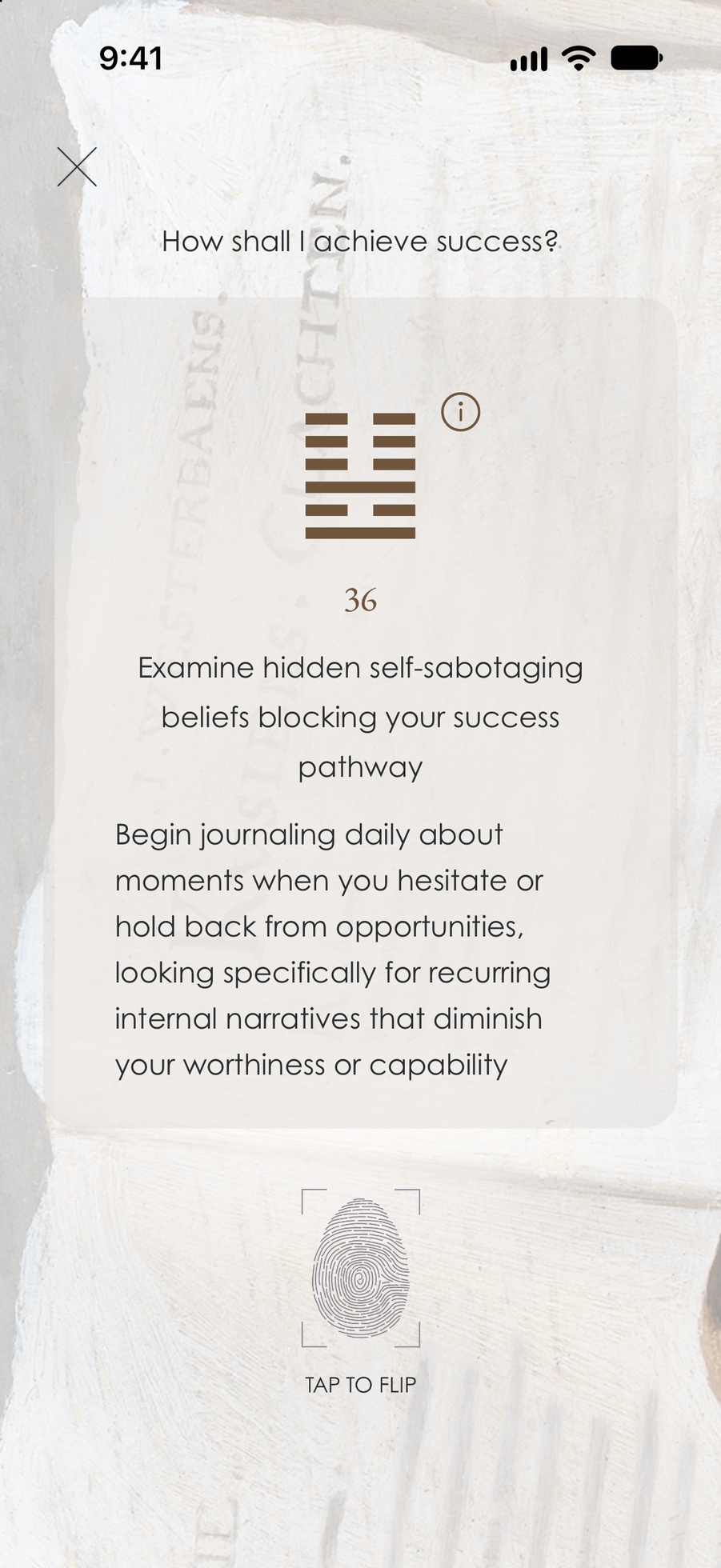
SEEK card for “How shall I achieve success?” with hexagram 36, the answer “Examine hidden self-sabotaging beliefs blocking your success pathway” and a prompt to journal about moments of hesitation.
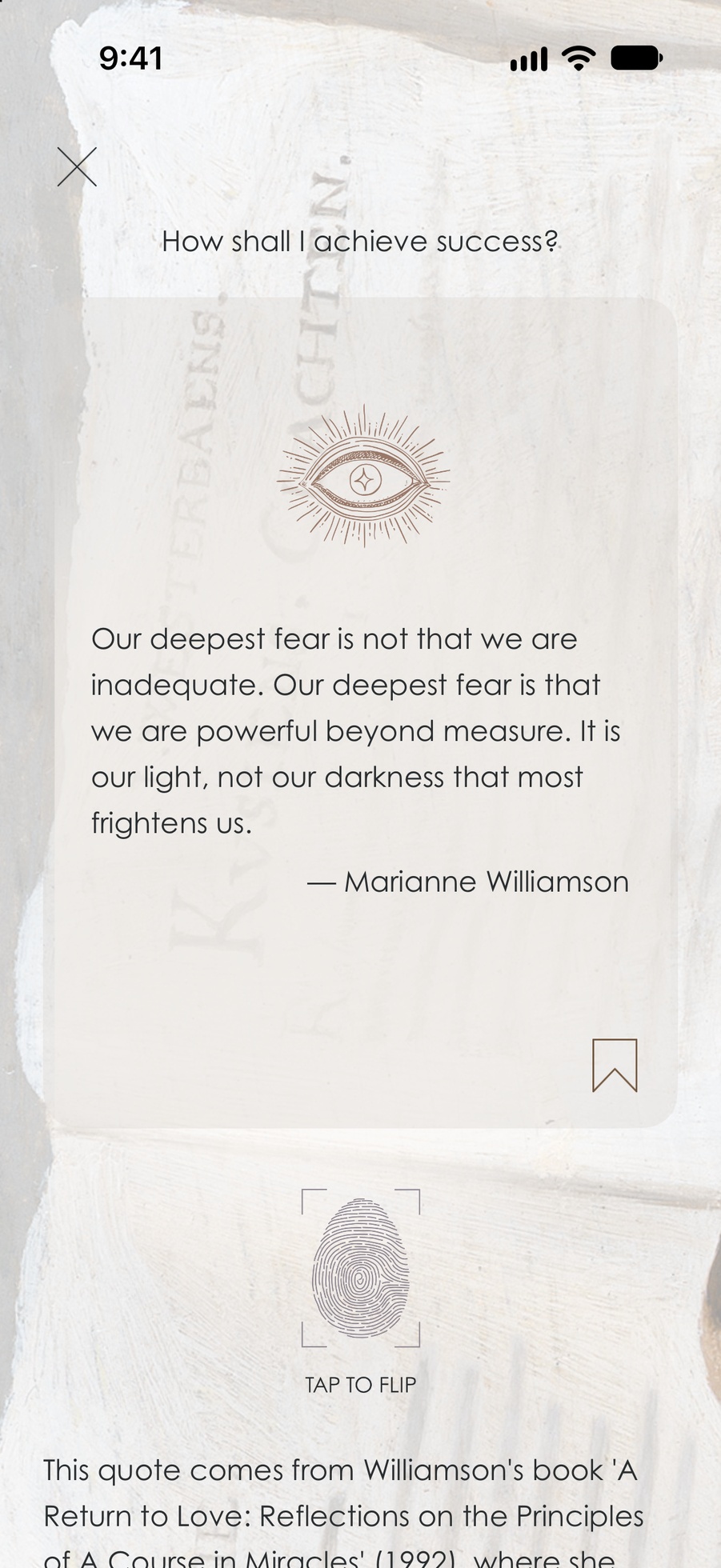
SEEK quote side showing “Our deepest fear is not that we are inadequate. Our deepest fear is that we are powerful beyond measure. It is our light, not our darkness that most frightens us.” credited to Marianne Williamson, above the opening of a note on A Return to Love.
In SEEK, a question about success draws hexagram 36 and a journaling prompt. The quote side of the same SEEK card credits Marianne Williamson and begins a note on her book. Source: Luminora on iPhone.

Questions readers also ask

Sources (2)

  1. “Quote Origin: Our Deepest Fear Is Not That We Are Inadequate. Our Deepest Fear Is That We Are Powerful Beyond Measure” · Quote Investigator · Reproduces the passage from A Return to Love (1992), chapter 7, page 165, with dated citations of the Mandela attribution.
  2. “‘Deepest fear’ quote not Mr Mandela’s” · Nelson Mandela Foundation (2007) · The Foundation’s statement on the three inauguration addresses.

Topics in this article: Quote origins · Reading · Misattributions